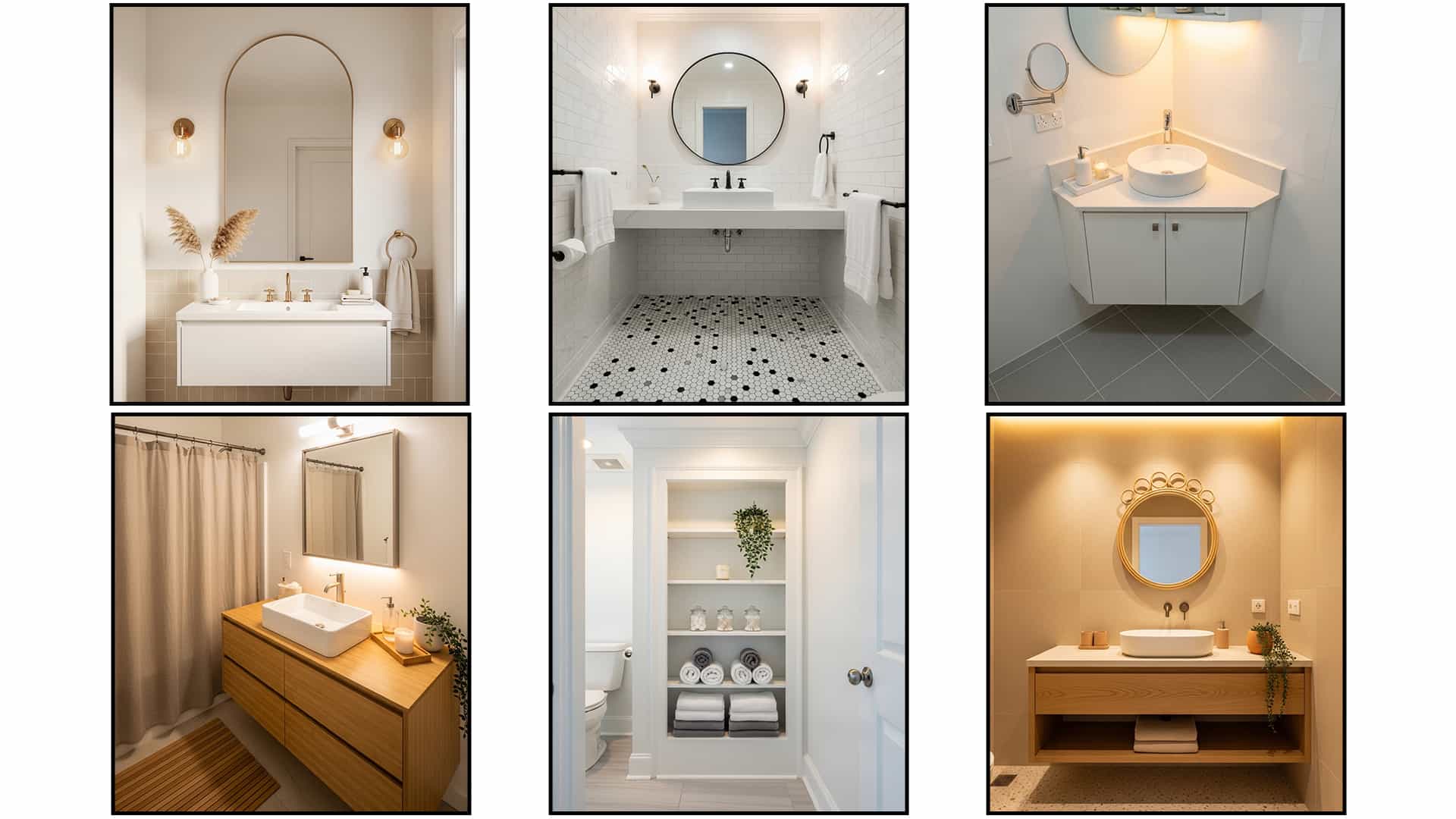
33 Gorgeous small bathroom design ideas To Copy In 2026
Your bathroom is the smallest room in the house , yet it holds the power to feel like the most luxurious. Most people stare at their cramped, dated bathroom every single morning and feel stuck. They assume a small footprint means limited style options. That assumption is completely wrong. The right small bathroom design ideas can turn even a forty-square-foot space into a room that looks intentional, beautiful, and genuinely spa-worthy.
I’ve seen bathrooms under fifty square feet that felt more impressive than large master bathrooms three times their size , simply because every design decision inside them was intentional and well-considered. A floating vanity here. A bold tile wall there. A skylight or an arched mirror. Small changes create massive visual results in compact spaces. Interior designers and bathroom stylists understand this principle deeply, which is why their compact bathroom transformations consistently generate the strongest audience reactions on every home decor platform.
This article covers 33 completely unique bathroom design ideas for 2026 , from minimalist Japandi layouts and moody dark tile rooms to vintage clawfoot tubs, frameless glass showers, and limewash plaster walls. Whether you are renovating a rental apartment bathroom, refreshing a powder room, or planning a full compact bathroom remodel, you will find ideas here that suit your style, your budget, and your space. Start reading, start saving your favorites, and start planning the bathroom your home has always deserved.
Floating Vanity With Storage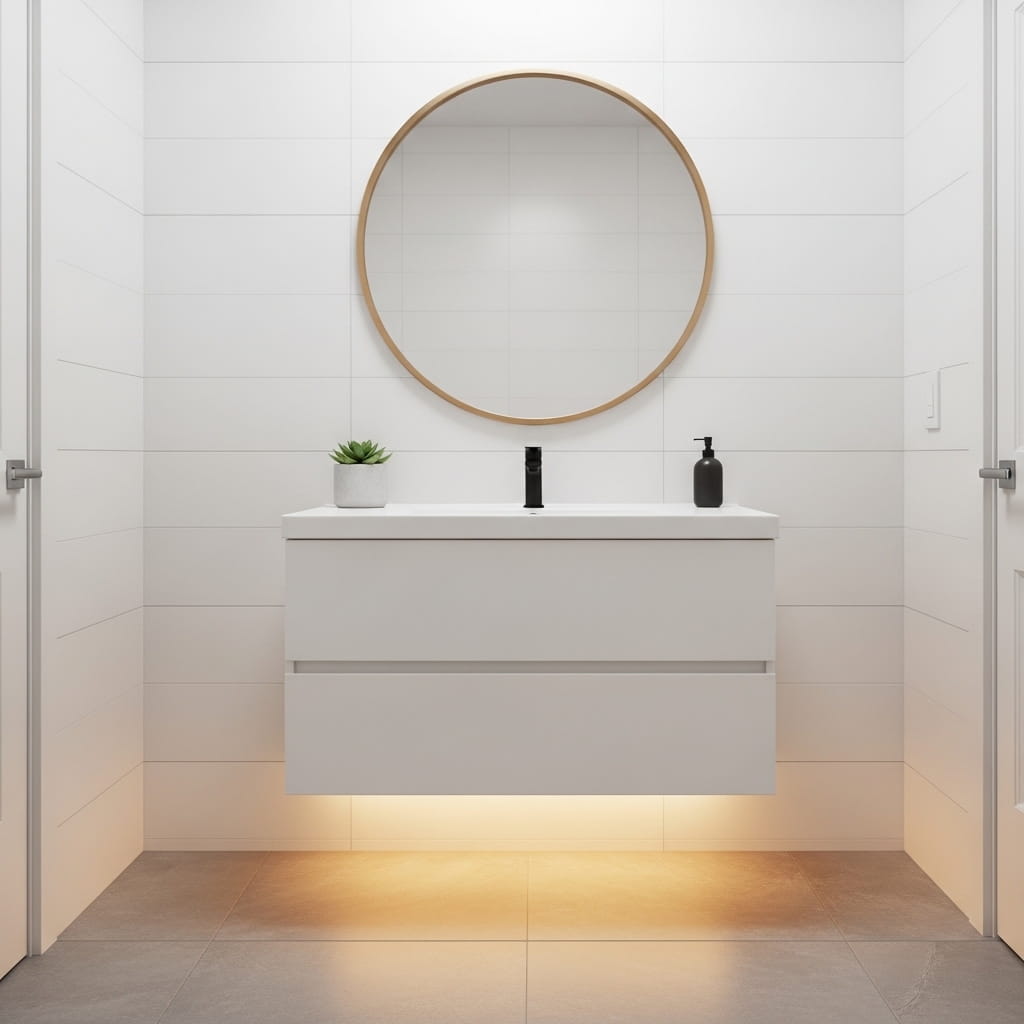
A floating vanity is one of the smartest small bathroom design ideas you can install because it creates visible floor space that makes the room feel measurably larger. The gap between the vanity base and the floor draws the eye across the full width of the room without any visual interruption. Warm LED strip lighting installed underneath the vanity adds a soft ambient glow at floor level that makes even the tiniest bathroom feel intentionally designed and spa-like.
White or light-toned floating vanities work best in compact bathrooms because they reflect natural and artificial light more efficiently than dark finishes. You choose a vanity with at least two deep drawers to maximize hidden storage for toiletries, hair tools, and cleaning supplies. This bathroom storage solution keeps the counter surface clear and uncluttered, which is the single most effective way to make a small bathroom feel organized and spacious.
- Creates visible floor space instantly
- Under-vanity lighting adds spa-like ambiance
- Deep drawers hide toiletry clutter effectively
- Light finishes reflect bathroom light beautifully
- Perfect for small apartment bathroom styling
Matte black or brushed gold hardware on the vanity drawers adds a designer detail that elevates the entire bathroom aesthetic without any renovation work. You pair the floating vanity with a large round mirror above it to further amplify the sense of open space at eye level. I’ve noticed that round mirrors above floating vanities consistently photograph as the most Pinterest-saved bathroom combination in small bathroom styling content.
Large format floor tiles running continuously from the bathroom entrance through the vanity area create a seamless visual flow that makes the floor look expansive rather than cut up into small sections. You choose tiles in a warm neutral or pale gray tone to maximize light reflection. The uninterrupted tile surface below the floating vanity , visible from one wall to the other , reinforces the open, airy quality that this bathroom layout idea achieves so effectively.
Walk-In Glass Shower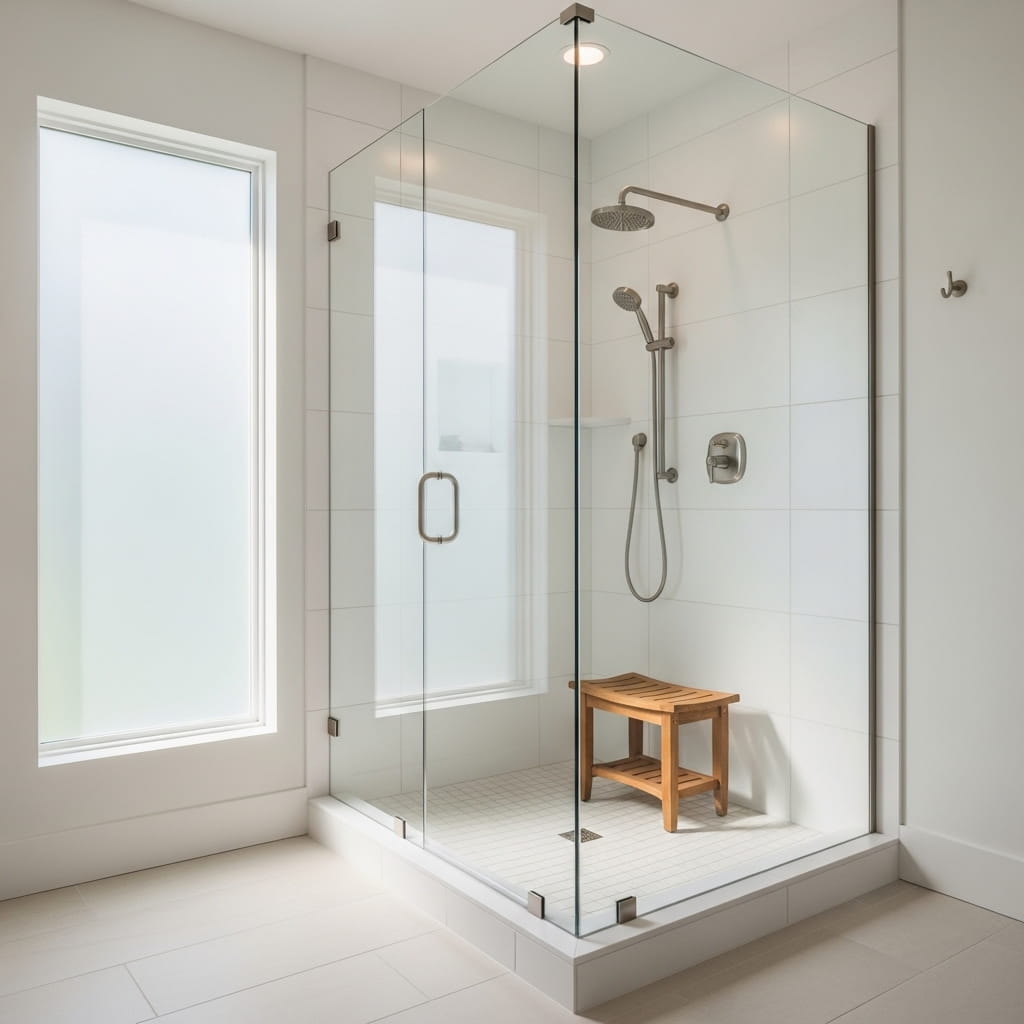
A frameless glass walk-in shower is the single most space-expanding upgrade you can make in a small bathroom remodel. The clear glass panel allows the eye to travel through the shower space and see the full depth of the room beyond it, which makes the bathroom feel dramatically larger than its actual square footage. This compact bathroom idea suits both apartment renovations and full home remodels wherever maximizing the sense of space is the primary design goal.
Continuing the same floor tile from the main bathroom floor directly into the shower without any threshold or curb creates a visual continuity that eliminates the visual break between the two zones. That uninterrupted tile flow is one of the most powerful optical tricks in small bathroom design because it removes the visual boundary that normally makes the shower feel like a separate, room-shrinking box. I’ve seen this single tile detail completely transform the perceived size of a bathroom under sixty square feet.
- Frameless glass visually expands bathroom space
- Continuous tile flow removes shower boundary visually
- Rain showerhead adds luxury spa-shower experience
- Teak bench adds warm organic shower detail
- Perfect for small bathroom remodel upgrades
A teak wood shower bench adds warmth and organic texture inside the glass shower without occupying significant floor space. You position it against the rear shower wall to keep the entry area completely open and unobstructed. The natural wood tone contrasts beautifully against the white tile walls and brushed nickel hardware, creating a spa-like material story inside a very compact shower space.
Brushed nickel hardware , shower rail, robe hook, and towel bar , throughout the bathroom maintains a consistent metallic finish that makes the small bathroom feel cohesive and professionally designed. You avoid mixing multiple hardware finishes in a small bathroom because visual consistency across all metal surfaces creates a calmer, more ordered environment. That hardware consistency is one of the design principles that interior specialists most frequently cite when advising on small bathroom makeovers.
Subway Tile Accent Wall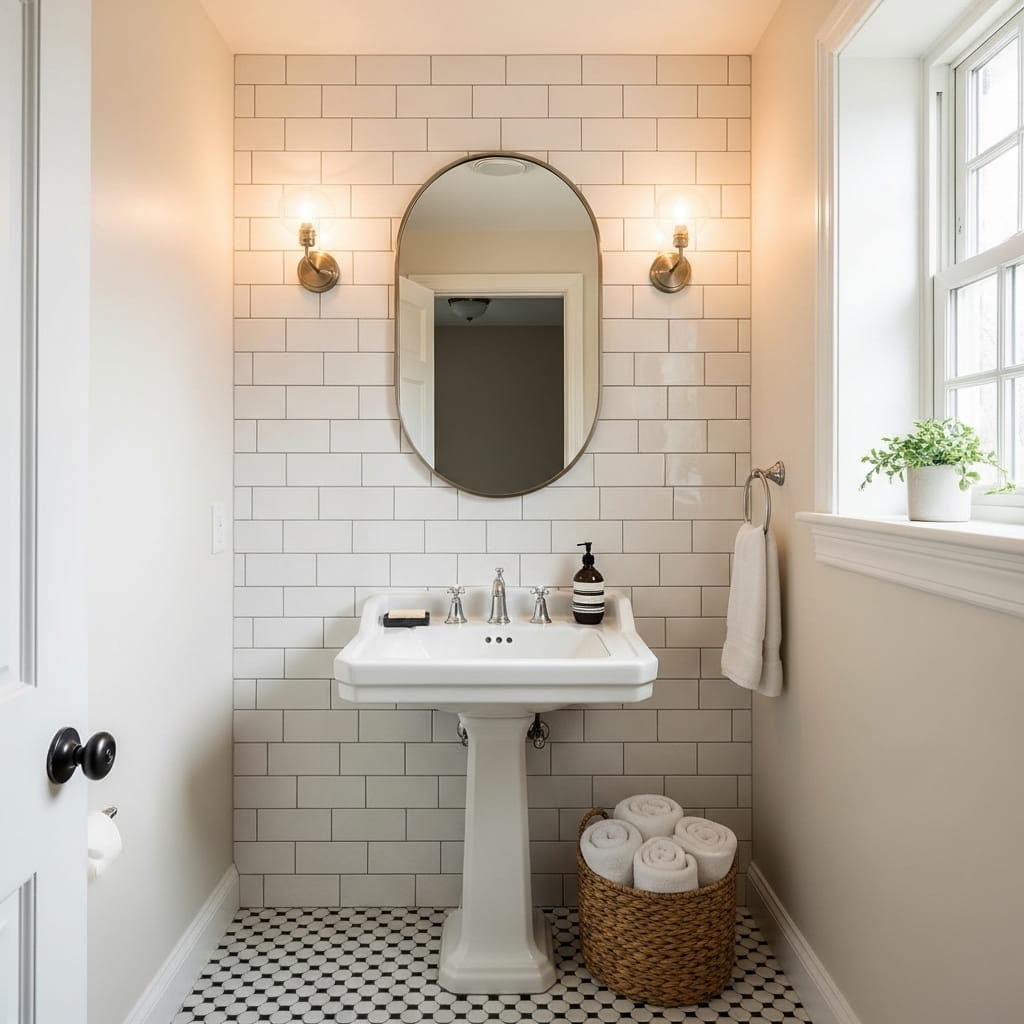
White beveled subway tile on the primary bathroom wall behind the sink creates a classic, timeless backdrop that adds architectural character to even the most compact bathroom. The beveled edge on each tile catches light slightly differently than a flat tile, creating a subtle three-dimensional shimmer across the wall surface throughout the day. This classic bathroom wall tile idea suits farmhouse, cottage, transitional, and vintage-inspired bathroom styles with equal visual appeal.
Pairing a white subway tile accent wall with warm cream paint on the remaining three walls prevents the bathroom from feeling like an all-white clinical space. The warm cream walls provide a soft, enveloping backdrop that makes the white subway tile pop with clean contrast while keeping the overall atmosphere cozy and welcoming. That’s why many bathroom designers recommend a single tiled feature wall paired with painted side walls as the most cost-effective tiling approach for compact bathroom renovations.
- Beveled tile creates subtle light-catching shimmer
- One tiled feature wall reduces renovation cost
- Cream walls keep the bathroom warm and cozy
- Black and white hex floor adds classic contrast
- Suits cottage, farmhouse, and vintage bathrooms
Black and white hexagon mosaic floor tiles add a classic vintage detail that grounds the bathroom design with bold pattern interest underfoot. The small hexagon format suits compact bathroom floor areas because the many individual tiles create visual texture that makes the floor look intentional and detailed without overwhelming the small space. A woven basket below the pedestal sink holds three to four rolled white towels and serves as practical floor-level storage.
A white oval or rectangular pedestal sink suits the subway tile wall backdrop perfectly because its clean, curved ceramic form connects naturally to the classic character of the subway tile. Pedestal sinks open up the floor below the sink area , much like a floating vanity , and create the same open, unobstructed floor plane that makes compact bathrooms feel larger. That floor visibility below the sink is particularly valuable in bathrooms smaller than forty square feet.
Vertical Shiplap Feature Wall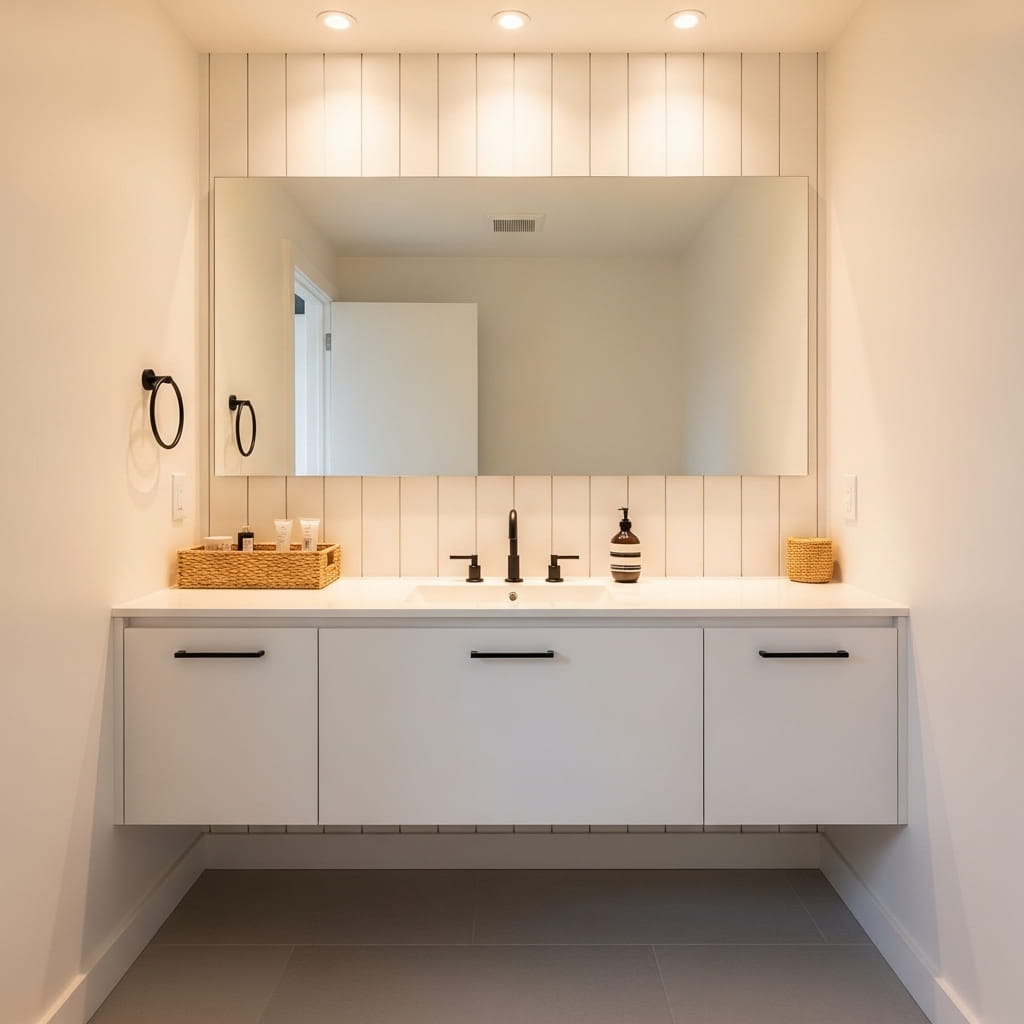
Vertical white shiplap paneling on the bathroom wall behind the vanity creates one of the most recognizable modern farmhouse bathroom looks while delivering a practical benefit most people overlook , vertical lines draw the eye upward and make low-ceilinged bathrooms feel measurably taller. The clean, linear texture of the shiplap boards adds architectural depth to an otherwise flat wall surface without requiring any tile work or permanent structural changes. This small bathroom wall idea suits rental apartments and owned homes equally.
Installing shiplap vertically rather than horizontally is the key design choice that maximizes the height-enhancing optical effect in compact bathrooms with standard eight-foot ceilings. Horizontal shiplap widens the visual perception of the room while vertical shiplap heightens it , and in a small bathroom where ceiling height is the most generous dimension, vertical paneling consistently delivers the most impactful visual result. I’ve noticed this specific detail makes a significant perceptual difference in bathrooms with ceilings below nine feet.
- Vertical lines draw the eye upward visually
- Shiplap adds texture without tile installation
- Rental-friendly with removable panel options
- Matte black hardware complements white shiplap
- Suits modern farmhouse and transitional bathrooms
Matte black faucets, towel rings, and cabinet hardware create a sharp, modern contrast against the white shiplap wall surface that keeps the bathroom looking intentionally designed rather than simply clean. The black hardware acts as a graphic accent that punctuates the white wall with deliberate visual emphasis at precisely the points where your hands interact with the bathroom most frequently. That design logic , accent hardware at touch points , is a technique many interior specialists apply in small bathroom styling.
A large rectangular mirror above the floating vanity amplifies the height-enhancing effect of the vertical shiplap boards by reflecting the full wall texture back into the room. The mirror essentially doubles the visual depth of the shiplap feature wall, making the bathroom feel twice as spacious in the vanity area. You choose a mirror that spans at least seventy percent of the vanity width for the most impactful reflective result.
Pedestal Sink With Open Shelving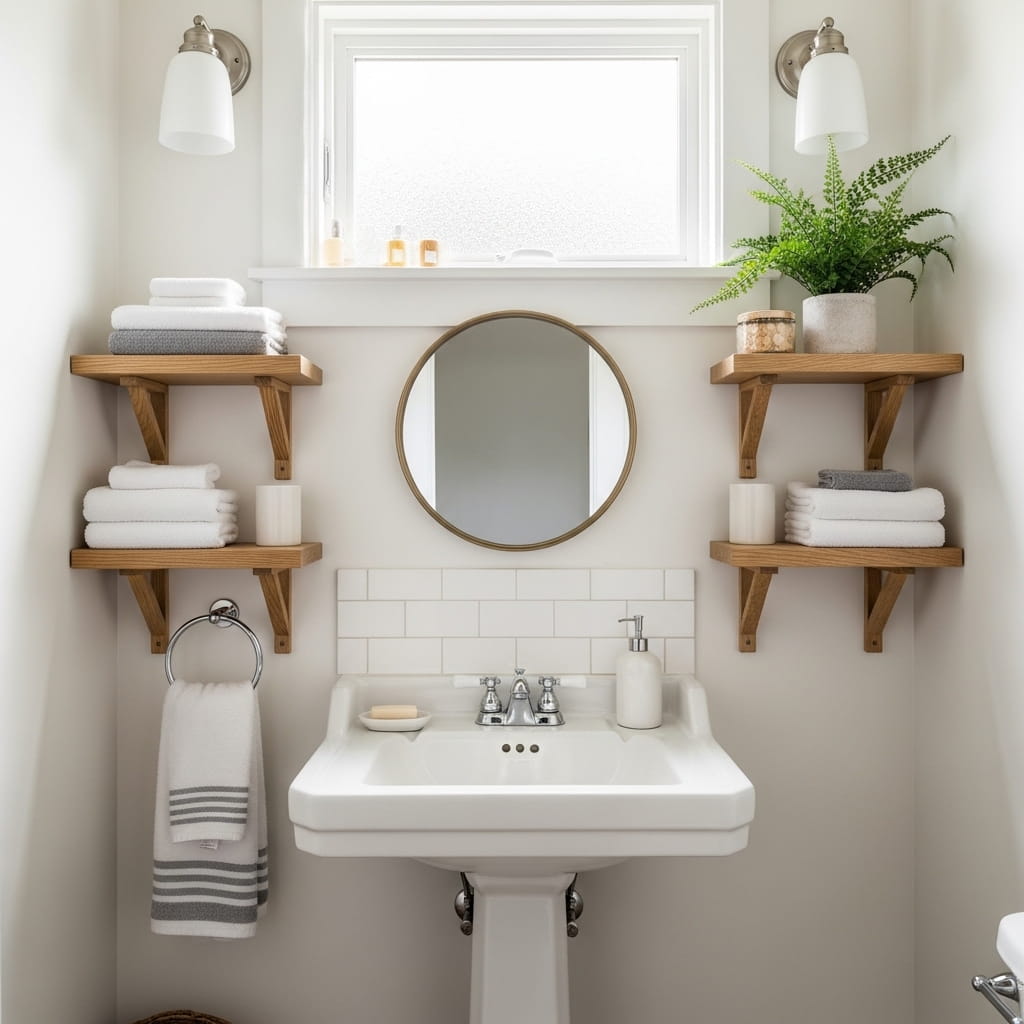
A pedestal sink flanked by two floating wooden shelves creates one of the most practical and visually balanced small bathroom layouts available without a vanity cabinet. The pedestal sink opens the floor completely while the shelves on either side provide the storage that the absent vanity cabinet would normally offer. This compact bathroom storage arrangement works particularly well in vintage, cottage, and minimal bathroom aesthetics where the exposed plumbing below a pedestal sink adds character rather than detracting from the design.
Floating wooden shelves at shoulder height on both sides of the mirror provide accessible storage for everyday bathroom items , folded towels, soap dispensers, small plants, and candles , without consuming any floor space. You install shelves in a warm white oak or pale pine finish to introduce natural material warmth alongside the hard ceramic and tile surfaces that dominate most compact bathroom environments. That wood-to-ceramic contrast adds visual variety that makes the bathroom feel layered and complete.
- Pedestal sink fully opens the bathroom floor
- Flanking shelves replace vanity cabinet storage
- Open shelving displays towels and accessories
- Natural wood shelves warm up tile-heavy bathrooms
- Suits vintage, cottage, and minimal bathroom styles
Neatly folding three to four white cotton towels on each shelf creates a clean, hotel-like display that makes everyday bathroom items look intentionally decorative. You add a small ceramic soap dispenser, a tiny glass candle, and a single small potted plant to each shelf for a layered, styled look. This shelf styling approach takes under five minutes to maintain and makes a significant difference to how organized and curated the overall bathroom feels on a daily basis.
A small round mirror in a brass or matte black frame above the pedestal sink suits the open-shelving bathroom layout because the circular shape prevents the mirror from visually crowding the flanking shelves on either side. Round mirrors in compact bathrooms consistently create a softer, more artistic focal point above the sink compared to large rectangular mirrors, which can overpower the balanced symmetry of the pedestal-and-shelf arrangement.
Dark Moody Tile Statement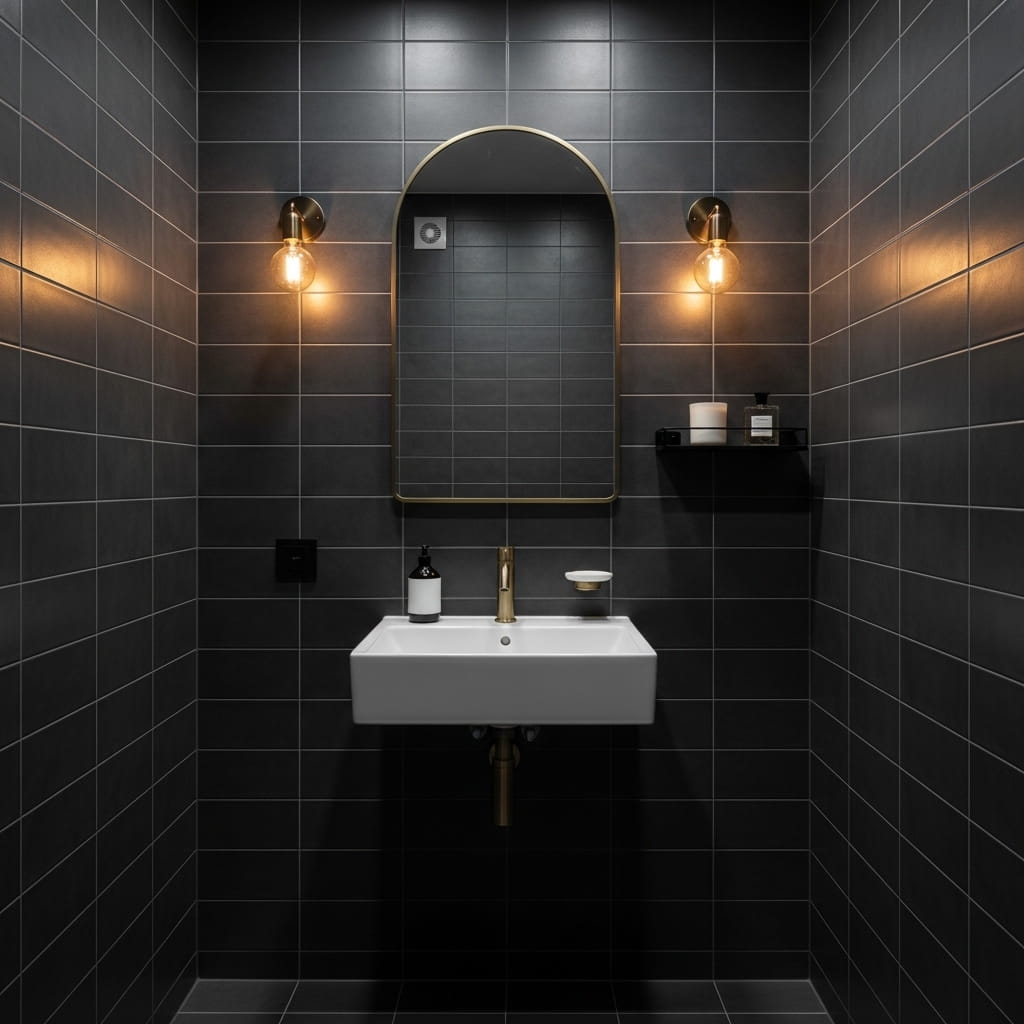
Dark moody tiles covering the floor to ceiling of a small bathroom create one of the most sophisticated and counter-intuitive bathroom design choices trending across USA interior design in 2026. Most people instinctively avoid dark colors in small bathrooms, assuming dark tones make small spaces feel smaller , but when a rich charcoal gray or deep slate tile covers every surface continuously, the room actually gains a cocooned, enveloping quality that feels deeply luxurious rather than cramped.
The full floor-to-ceiling tile application in one continuous dark tone removes all visible boundaries between the floor, walls, and ceiling, which paradoxically makes the room feel larger than a space broken up by contrasting colors across different surfaces. That’s why many bathroom designers describe the full-coverage dark tile approach as one of their most effective small bathroom design ideas for clients who want dramatic, high-end results in a limited footprint.
- Full dark tile coverage creates luxury cocooning effect
- Removes visual boundaries between floor and walls
- Warm sconce lighting prevents the dark feel
- Brass hardware adds warmth against charcoal tile
- Suits moody, dramatic, and luxury bathroom styles
Warm amber Edison bulb sconces on either side of the mirror are essential for preventing the dark tile bathroom from feeling oppressive or cave-like. The warm amber light source at eye level fills the charcoal tile surfaces with a soft, glowing warmth that shifts the atmosphere from dark and cold to dark and intimate. I’ve seen this specific lighting choice completely change a client’s emotional response to a dark bathroom from anxiety to genuine delight.
A brushed gold faucet and thin brass mirror frame provide the essential warm metallic accent that prevents the charcoal tile from looking cold and industrial. The gold and brass tones belong naturally to the warm amber light in the sconce fixtures, creating a consistent warm-tone thread that runs across the hardware, the lighting, and the mirror frame simultaneously. That visual consistency is what makes a moody dark bathroom feel designed rather than simply dark.
Minimalist White Spa Bathroom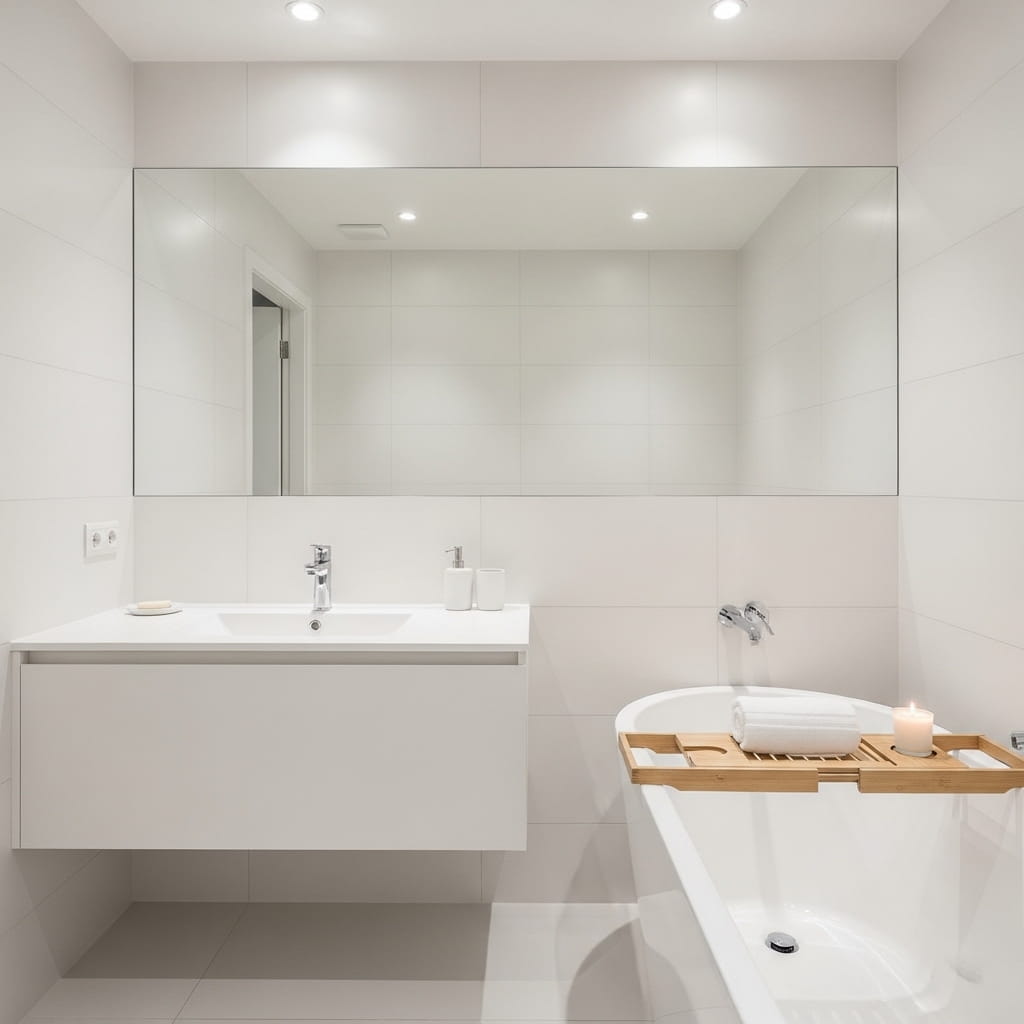
An all-white minimalist spa bathroom creates the most calming and visually expansive atmosphere possible in a compact bathroom footprint. Every surface , tile, vanity, sink, and tub , shares the same clean white color family, which eliminates all visual fragmentation and makes the room feel like one continuous, uninterrupted space. This bathroom design approach suits people who want their small bathroom to feel like a private retreat where visual complexity and clutter simply do not exist.
Choosing large format white matte tiles rather than small white tiles for the walls and floor reduces the number of grout lines visible across the entire bathroom surface. Fewer grout lines mean less visual interruption across the tile surface, which makes the walls and floor look cleaner, larger, and more continuous. That’s why interior specialists consistently recommend large format tiles as one of the most practical small bathroom design ideas for homeowners pursuing a spa-like aesthetic.
- Large white tiles reduce visible grout lines
- All-white palette unifies the full bathroom visually
- Freestanding tub adds luxury in a compact corner
- Bath tray keeps tub surface styled and organized
- Polished chrome adds clean, reflective metal detail
A deep freestanding soaking tub in a compact bathroom corner functions as both a luxurious bathing fixture and a powerful design statement that gives the small bathroom a grand, spa-hotel quality. You position the tub under a window or against the longest unobstructed wall to maximize the visual impact of its silhouette against the clean white tile background. A white oak wood bath tray laid across the tub holds a single white candle, a small plant, and a bar of artisan soap.
Recessed overhead lighting in a white spa bathroom maintains the clean, uninterrupted ceiling surface by eliminating the visual clutter of exposed pendant or wall-mount light fixtures. You dim the recessed lights to fifty percent brightness during bath time to create a soft, warm atmosphere that reinforces the spa-like quality of the space. This lighting flexibility , from bright task light to soft ambient glow , is one of the most practical upgrades you can make in a small bathroom renovation.
Earthy Warm Tile Palette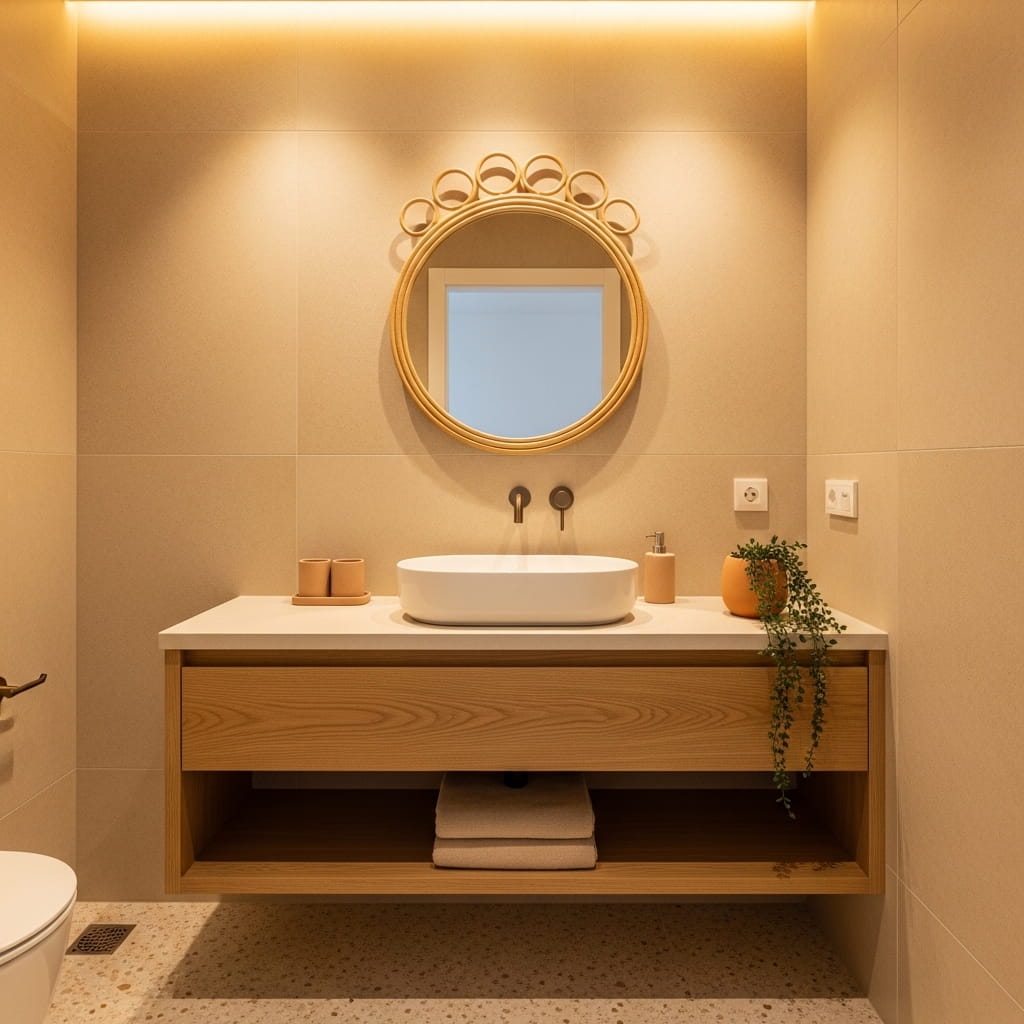
Warm sandy beige wall tiles paired with a cream terrazzo floor and a natural oak wood vanity create one of the most grounded, organically beautiful small bathroom palettes trending in 2026. The warm earthy tones across the tile, floor, and wood surfaces create a continuous warm cocoon that makes the bathroom feel nourishing and deeply restful to be in. This bathroom design direction suits organic modern, warm contemporary, and biophilic interior styles with outstanding natural beauty.
Natural materials , stone-look tile, wood vanity, terrazzo floor, rattan mirror frame, and terracotta plant pot , each contribute to a layered organic material story that feels collected rather than purchased as a matching set. That sense of collected warmth is what makes an earthy bathroom palette feel so much more personal and alive than a single-material, single-tone bathroom design. I’ve noticed that bathrooms with organic material variety consistently generate the strongest emotional responses from visitors encountering them for the first time.
- Sandy beige tiles create warm earthy backdrop
- Terrazzo floor adds natural textural interest
- Oak wood vanity brings organic warmth and storage
- Rattan mirror frame adds natural material depth
- Suits organic modern and biophilic bathroom styles
Brushed bronze hardware throughout the bathroom , faucet, towel ring, and cabinet pulls , ties the warm earthy material palette together under a single warm metallic tone that echoes the natural wood and terracotta elements already present in the design. Bronze belongs naturally to the warm brown and orange tonal family shared by the oak wood, the sandy tile, and the terracotta plant pot. That color family relationship across five different bathroom materials creates a deeply cohesive design story.
Open lower shelving on the oak wood vanity displays a small terracotta pot with a trailing plant, two rolled cream towels, and a woven basket for hidden toiletry storage. This open shelf styling turns the vanity base into a display surface that adds personality and organic warmth to the bathroom design without requiring any decorative purchases beyond the plant and the basket. The combination of living plant material and natural organic textures at vanity base level creates a bathroom that feels genuinely welcoming rather than purely functional.
Bold Black Hexagon Floor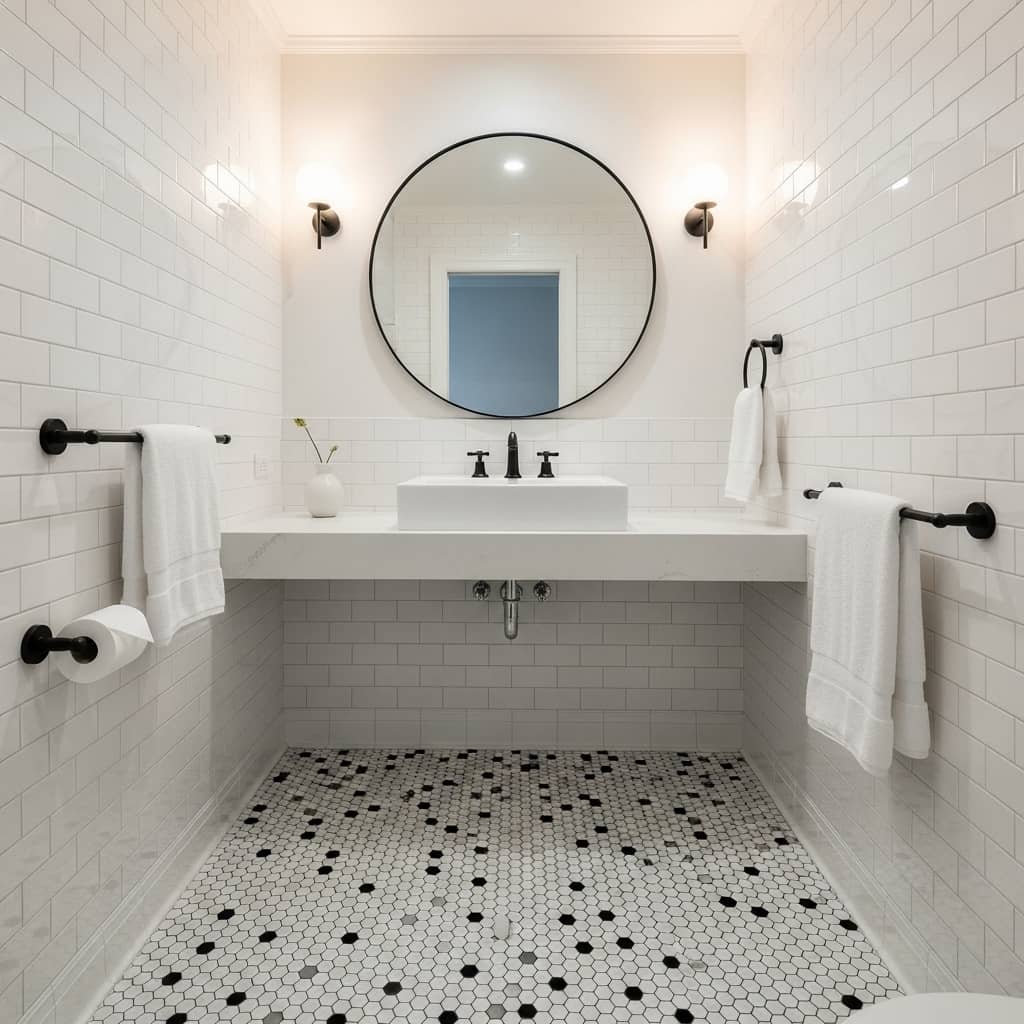
A bold black and white hexagon mosaic tile floor instantly gives a small bathroom a graphic, vintage-inspired personality that makes the compact space feel deliberately designed from the ground up. The high-contrast black and white pattern creates a visual anchor underfoot that draws the eye downward and makes the floor the undisputed focal point of the bathroom design. This small bathroom floor tile idea suits vintage, art deco, classic, and graphic modern bathroom styles with remarkable design confidence.
Pairing the bold hexagon floor with white subway tile walls creates a classic, harmonious backdrop that prevents the graphic floor from feeling visually competitive or chaotic. The white walls calm the room above the waistline while the patterned floor delivers all the visual energy and personality below it. That deliberate division of visual work , bold below, calm above , is one of the most timeless and effective design strategies in small bathroom styling.
- Bold hex pattern anchors the bathroom design visually
- White subway walls balance the graphic floor tile
- High contrast black and white pattern is timeless
- Matte black accessories echo the dark hex tile
- Suits vintage, art deco, and classic bathroom styles
Matte black hardware , towel bars, toilet paper holder, and mirror frame , on the white subway tile walls creates a deliberate visual echo of the black hexagon tiles on the floor. The black hardware ties the upper wall zone to the floor zone through color repetition, creating a visual top-and-bottom bookend effect that makes the bathroom design feel fully resolved. That’s why many bathroom stylists specify matte black hardware as the default accessory choice when designing for a black-and-white hex floor bathroom.
A large round mirror in a thin matte black frame above the pedestal sink completes the graphic black-and-white design story at eye level. The round shape provides a soft contrast to the angular hexagon tiles below it, creating a visual tension between geometric forms , round above, angular below , that keeps the bathroom design interesting from multiple viewing angles. This combination of hexagon floor, subway wall, and round mirror is one of the most pinned small bathroom design combinations of 2026.
Corner Shower Niche Storage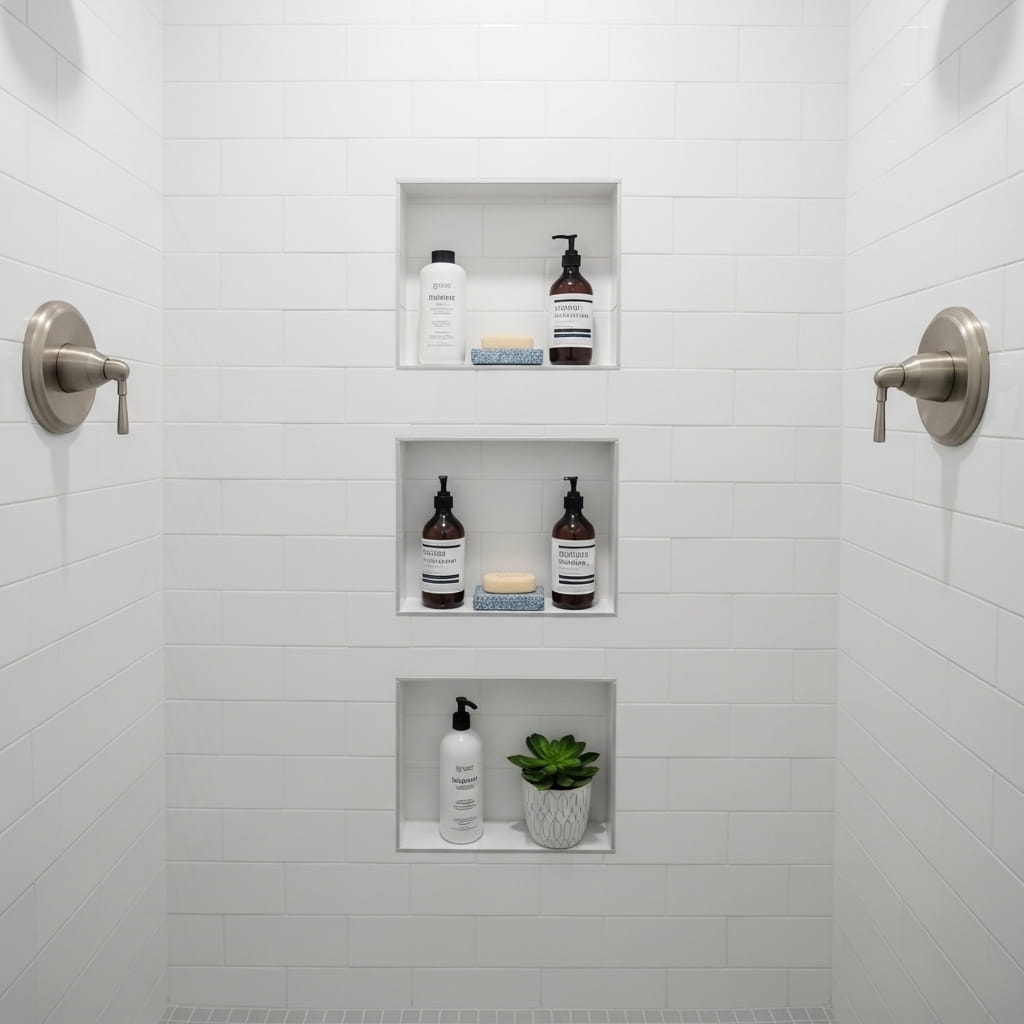
Recessed wall niches built directly into a shower wall solve the single most frustrating small bathroom storage problem , where to put shampoo, conditioner, and soap without a bulky caddy cluttering the shower space. A built-in niche sits flush with the tile surface and adds zero visual bulk to the shower while providing accessible, organized storage at exactly the height where you need it most. This compact bathroom storage idea suits every shower style from minimalist to farmhouse to spa-inspired.
Installing three niches at three different heights serves three distinct practical purposes simultaneously. A high niche holds rarely used bottles and backup products. A mid-height niche holds daily shampoo and conditioner. A lower niche holds a soap bar and a small shower brush. That height-differentiated storage system eliminates the need for any external shower organizer or adhesive shelf, keeping the shower tile surface completely clean and uninterrupted from every angle.
- Built-in niches eliminate bulky shower caddies
- Three heights serve three different storage needs
- Recessed design keeps shower walls visually clean
- Tile the niche in a contrasting material for detail
- Works in both walk-in and enclosed shower designs
Tiling the interior back wall of each niche in a contrasting material , a small mosaic tile, a zellige accent, or a patterned encaustic tile , adds a beautiful decorative detail that turns a purely functional storage solution into a design feature. The contrasting niche tile creates three small framed vignettes of pattern and color within the otherwise uniform tile wall. I’ve seen this single design detail make a plain white tile shower look dramatically more considered and finished.
A small waterproof ceramic pot holding a single succulent inside the lowest niche adds a living botanical detail to the shower wall that feels unexpectedly warm and personal. Certain succulent varieties tolerate the humid shower environment well when the shower is ventilated properly. This organic living element inside the shower niche is one of those small bathroom styling ideas that consistently generates saves and comments when photographed for Pinterest content.
Arched Mirror Statement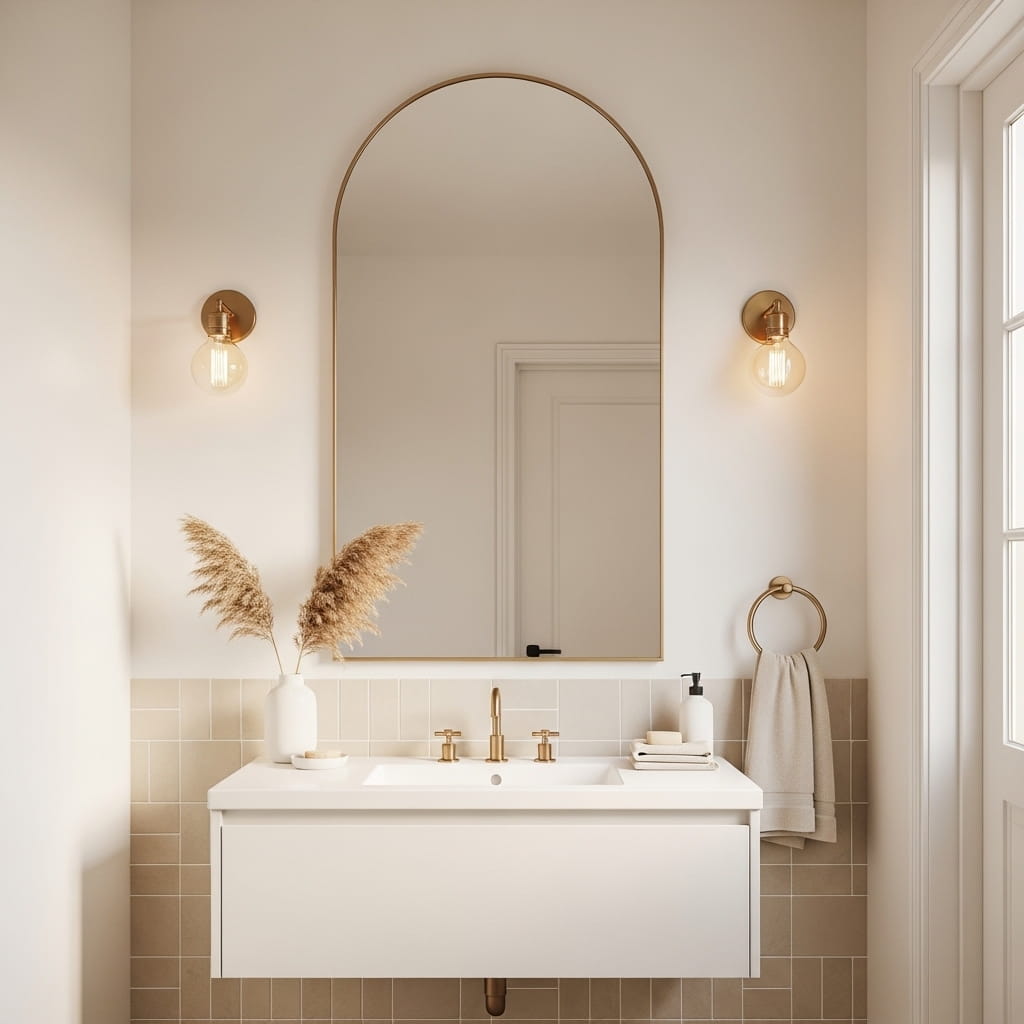
A large arched mirror above a bathroom vanity creates an instant architectural focal point that makes the entire bathroom feel more designed, more spacious, and more intentionally beautiful. The arch shape introduces a soft, romantic geometry that contrasts beautifully against the hard right angles of tile walls, vanity edges, and door frames. This bathroom mirror idea works particularly well in compact bathrooms because the large reflective surface doubles the visual depth of the room at the most visually important wall.
Arched mirrors in brushed gold or warm brass frames suit the soft, organic modern and romantic bathroom aesthetics trending most strongly across USA interior design in 2026. The warm metal frame amplifies the romantic character of the arch shape while connecting to warm-toned hardware and lighting throughout the bathroom. That’s why many interior designers describe an arched brass mirror as the single most impactful decorative investment for a small bathroom makeover on a limited budget.
- Arched mirror adds instant architectural character
- Large reflective surface doubles the room visually
- Brushed gold frame suits warm romantic bathrooms
- Arch shape softens right angles throughout the space
- Dramatic focal point above any vanity style
Warm amber wall sconces positioned symmetrically on each side of the arched mirror provide the most flattering and visually balanced bathroom lighting available. Flanking sconces at eye level eliminate the harsh shadows that overhead lighting creates on the face and fill the entire mirror surface with a warm, even glow. The warm amber bulbs in the sconces amplify the soft romantic atmosphere that the arched mirror and brushed gold frame establish throughout the bathroom.
A small white ceramic vase holding dried pampas grass on the vanity counter beneath the arched mirror creates a styled vignette that frames the base of the mirror with organic warmth. The dried pampas fronds extend upward toward the arch and create a visual connection between the counter surface and the mirror above. This small accessory detail , costing under twenty dollars , adds the final layer of intentional styling that makes the arched mirror bathroom look fully complete and professionally decorated.
Wallpaper Powder Room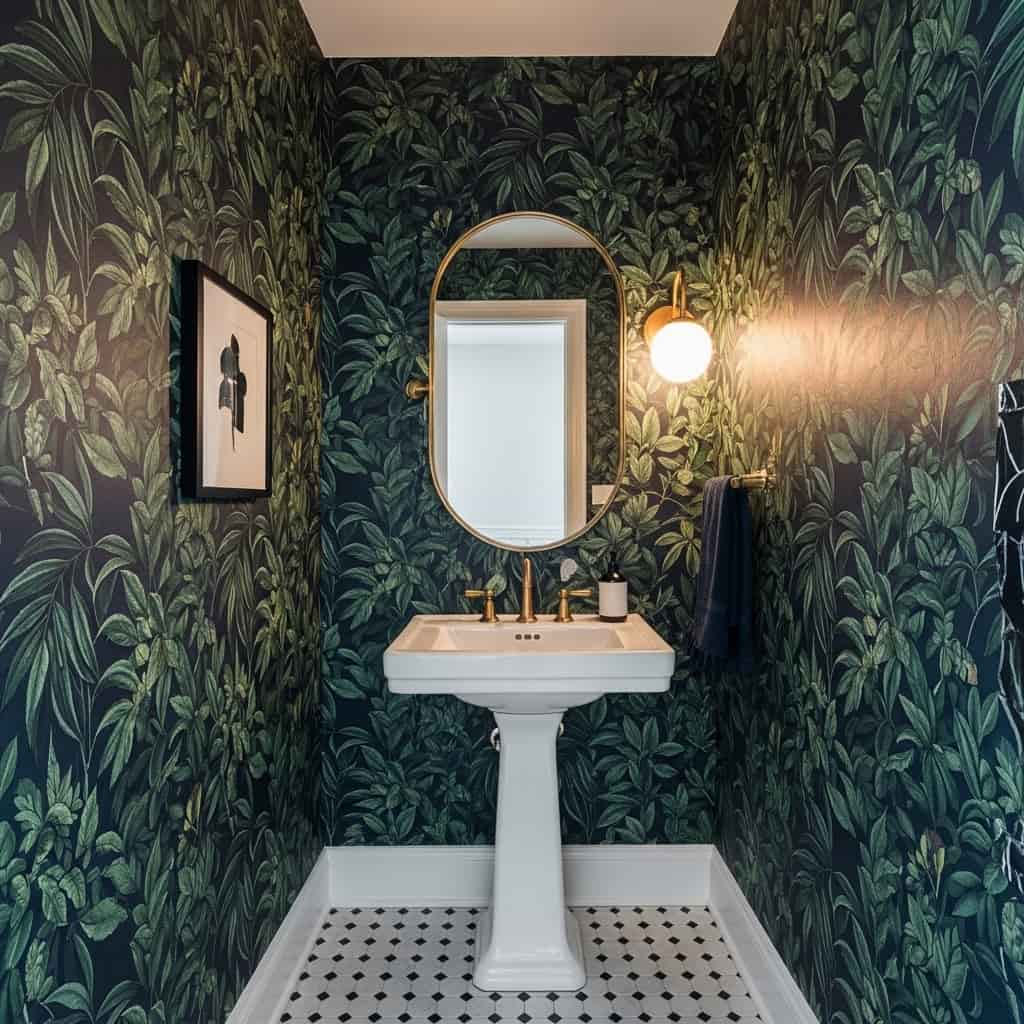
A small powder room covered in dramatic botanical wallpaper on all four walls is one of the boldest and most rewarding small bathroom design ideas available because small spaces are the safest place to commit to a bold wallpaper choice. The limited square footage means the dramatic pattern never becomes overwhelming , instead, it creates a jewel-box effect that makes the tiny room feel like a destination rather than a utility space. Powder rooms and half bathrooms are the ideal testing ground for wallpaper patterns you would never dare use in a larger room.
Deep navy, forest green, and botanical print wallpapers are three of the top wallpaper choices for USA powder rooms in 2026 because they work particularly well with the warm brass and gold hardware finishes that dominate current bathroom design trends. The dark, saturated wallpaper background makes the warm gold hardware fixtures , faucet, mirror frame, and sconce , pop with striking metallic contrast. I’ve seen this specific combination turn a previously ignored half bathroom into the most talked-about room in an entire house.
- Full-wall wallpaper creates instant jewel-box drama
- Small spaces make bold wallpaper feel contained
- Navy botanical print suits warm brass hardware
- Checkered floor adds classic graphic contrast below
- Perfect for powder rooms and half bathrooms
Black and white diamond checkered floor tile adds a second layer of bold pattern at floor level that grounds the dramatic wallpaper walls with an equally confident base. Mixing bold patterns in a small powder room works when the patterns occupy different planes , vertical wallpaper on the walls, horizontal tile on the floor , so the two patterns never visually compete directly with each other. That plane separation between pattern applications is the key design rule that makes pattern mixing in small bathrooms succeed.
A small oval mirror in a brushed brass frame and a single warm globe sconce beside it create a warmly lit, intimate vanity vignette that suits the jewel-box atmosphere of the wallpapered powder room perfectly. The small scale of the mirror and the single sconce keep the vanity area appropriately proportioned for the small sink wall without overwhelming the dominant wallpaper pattern behind them. Every fixture in this bathroom remains deliberately small-scale so the wallpaper can command the full visual attention it deserves.
Sage Green Vanity Cabinet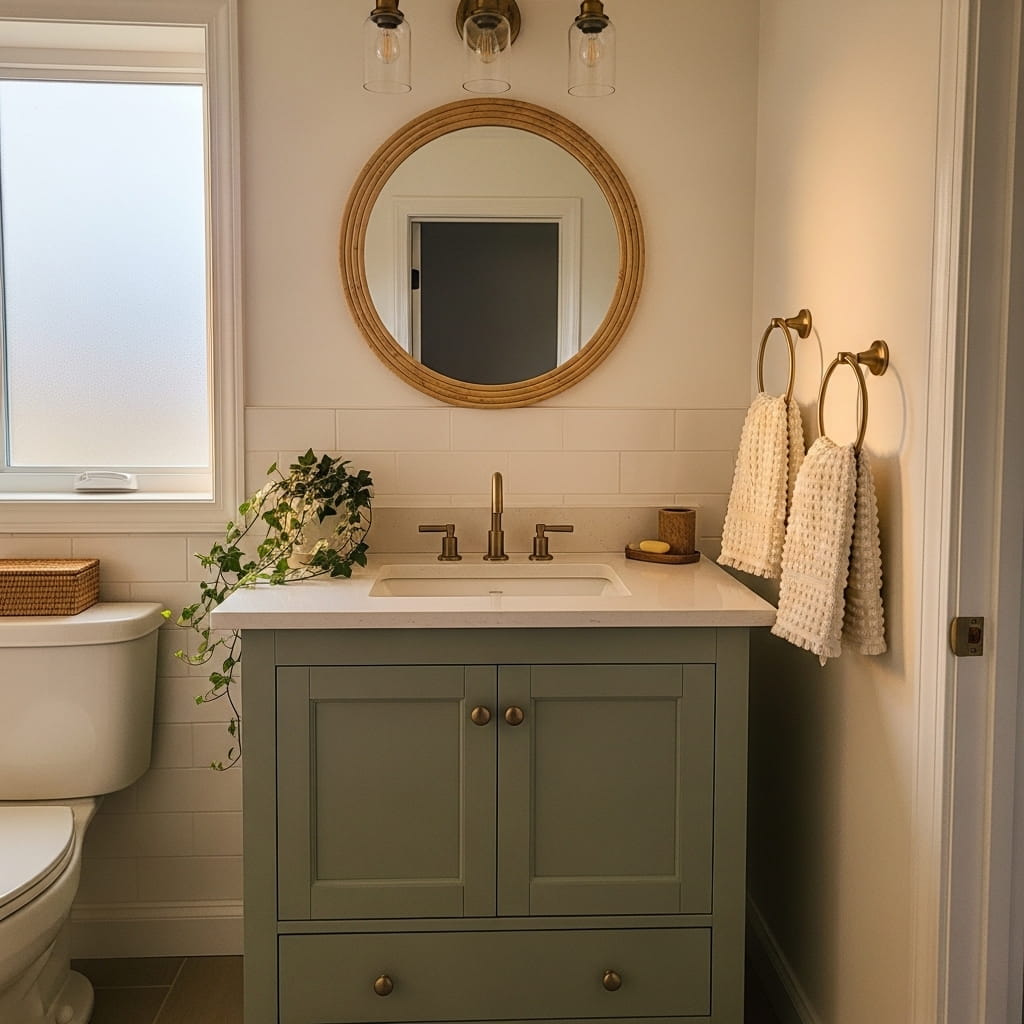
A sage green vanity cabinet is one of the most versatile and widely loved bathroom cabinet color choices in 2026 because sage green reads simultaneously as a bold color choice and a warm neutral depending on the lighting conditions in the bathroom. Under warm morning daylight, sage green looks rich, earthy, and deeply welcoming. Under cool overhead lighting, it reads as a soft, sophisticated gray-green. That lighting versatility makes sage green the most forgiving bold cabinet color you can choose for a compact bathroom renovation.
Sage green suits a remarkably wide range of bathroom tile and hardware combinations, which makes it a practical color choice for homeowners who want to refresh their bathroom with a new vanity without replacing all the existing tile and fixtures. You pair sage green with white subway tiles, cream penny tiles, warm beige stone tiles, or even dark charcoal hex tiles , and the sage green vanity connects naturally to all of them. That color compatibility breadth is what makes sage green such a popular small bathroom cabinet choice.
- Sage green suits warm and cool lighting equally
- Pairs naturally with white, cream, and charcoal tiles
- Brass hardware amplifies sage green’s earthy warmth
- Rattan mirror adds organic natural material contrast
- Perfect for farmhouse and organic modern bathrooms
Brushed brass hardware on the sage green cabinet doors and drawer amplifies the earthy, botanical warmth already present in the sage tone. The warm gold of the brass connects the vanity cabinet to the warm natural materials , rattan mirror frame, cream quartz countertop, and woven cotton towels , throughout the rest of the bathroom design. A small potted trailing ivy on the vanity counter reinforces the organic, botanical character of the sage green color with a living plant that matches the cabinet’s botanical spirit.
A round rattan-framed mirror above the sage green vanity adds a natural material contrast that prevents the bathroom from feeling too coordinated or showroom-like. The rattan frame’s organic woven texture belongs to the same natural material family as the woven cotton towels and the trailing ivy plant, creating three natural texture references at three different heights across the bathroom design. That layered organic material story is what gives this bathroom its warm, collected, and genuinely personal character.
Terrazzo Floor Bathroom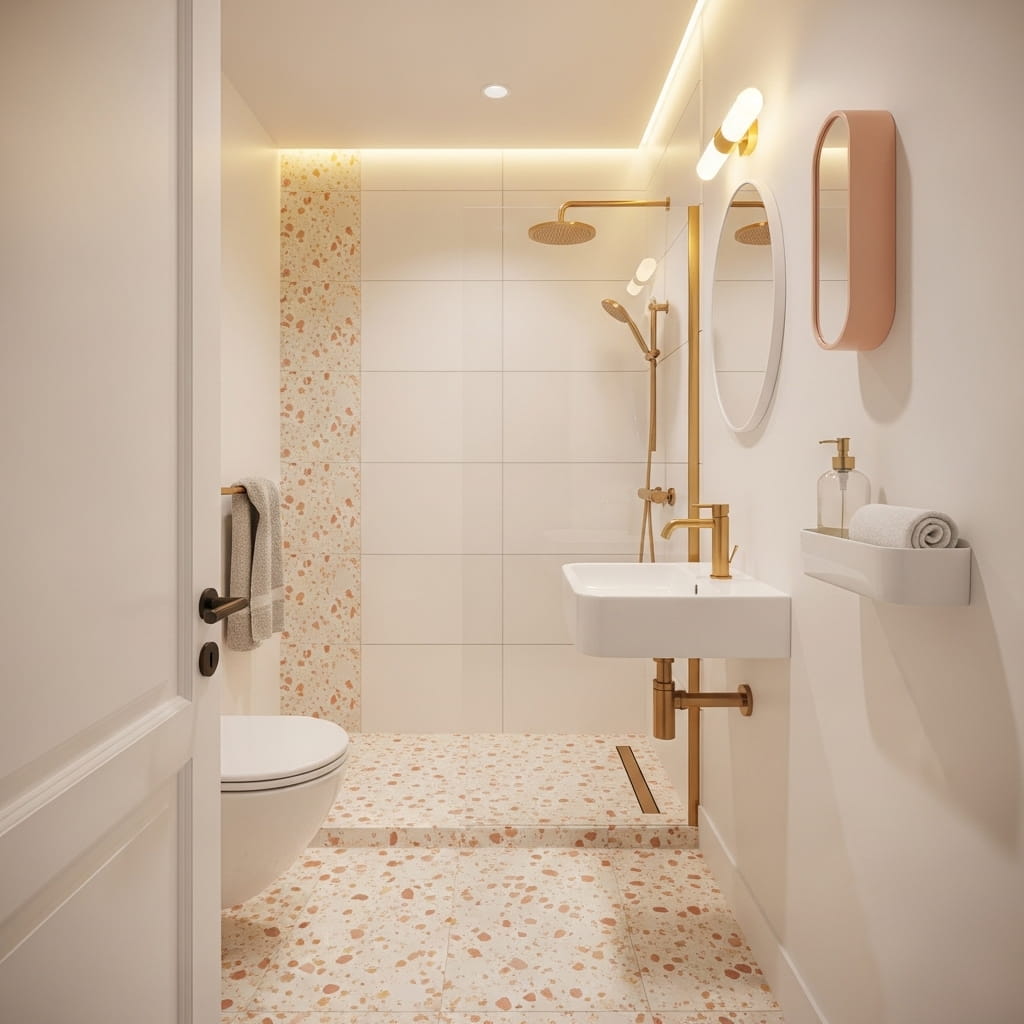
Terrazzo floor tiles bring a playful, organic energy to a compact bathroom that no other flooring material quite replicates. The scattered chip pattern in terrazzo , mixing cream, pink, gray, and white fragments in a smooth surface , creates a naturally varied, textural floor that looks handcrafted and genuinely artistic without requiring any complex tile pattern installation. A cream and pale pink terrazzo floor is one of the most photographed small bathroom floor choices trending across USA home decor platforms throughout 2026.
Terrazzo’s smooth, hard surface is highly practical in a small bathroom because it is waterproof, slip-resistant when textured, easy to clean, and extremely durable over decades of daily use. The organic chip pattern also hides minor water spots and soap residue far more effectively than a plain single-color tile, which means the terrazzo floor consistently looks clean between cleaning sessions. That practical quality makes terrazzo an excellent material choice for high-traffic compact bathrooms in both apartments and family homes.
- Scattered chip pattern creates artistic floor texture
- Terrazzo hides water spots between cleaning sessions
- Cream and pink tones suit warm modern aesthetics
- Durable and waterproof for high-traffic bathrooms
- One of 2026’s most Pinterest-viral bathroom floors
Pairing the terrazzo floor with large format white wall tiles and a white wall-mounted sink keeps the upper bathroom zone calm and clean so the terrazzo floor can serve as the clear visual star of the design. The white walls and white sink act as a neutral canvas that makes the terrazzo pattern pop with full visual impact at floor level. That design logic , bold below, neutral above , is the same principle that makes bold hexagon tiles and patterned encaustic tiles work so successfully in compact bathrooms.
A brushed gold faucet and a small round pill-shaped mirror in a matching gold frame add warm metallic accents that connect to the warm cream and pink tones in the terrazzo floor below them. The pill mirror shape echoes the soft, rounded organic character of the terrazzo chip pattern and creates a visual rhyme between the floor material and the mirror shape. This subtle geometric connection between floor and mirror is the kind of thoughtful design detail that makes a bathroom look professionally styled.
Scallop Tile Shower Wall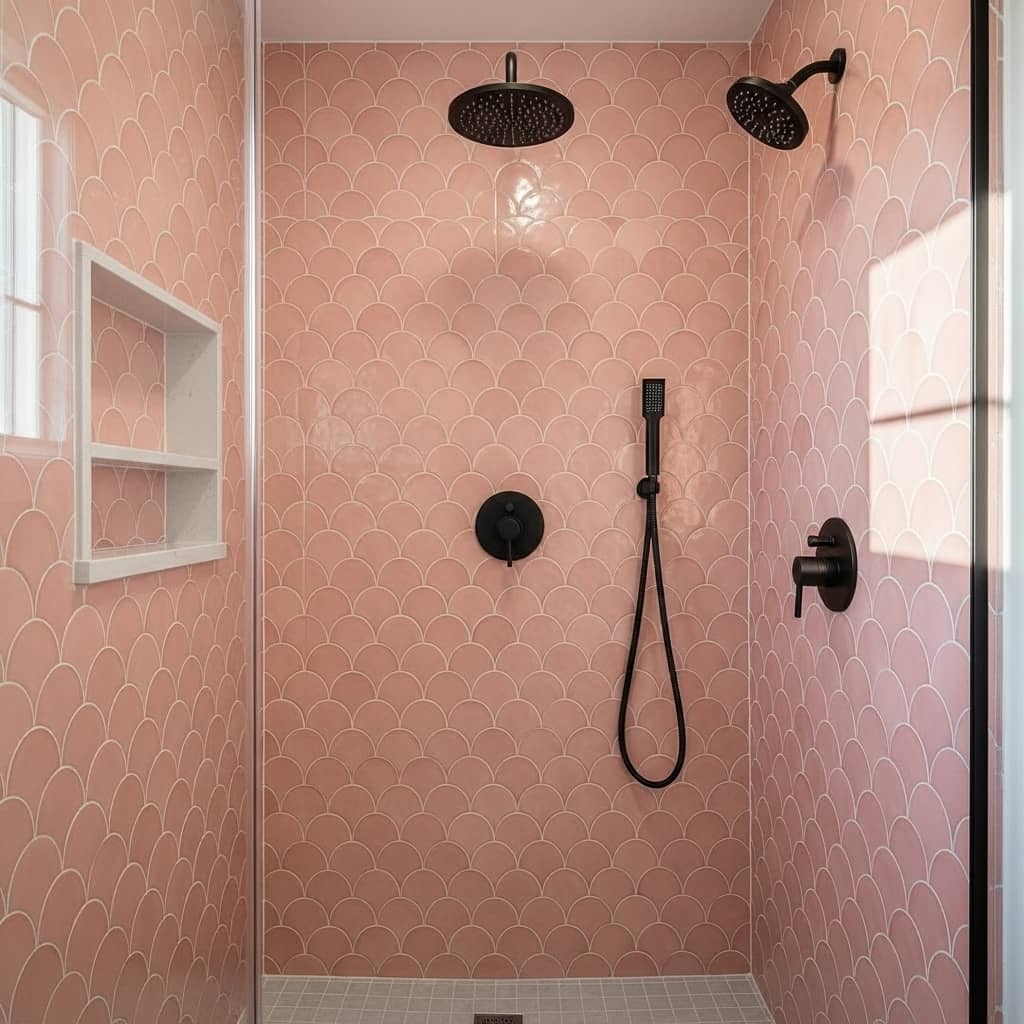
Scallop-shaped tiles on a shower wall create one of the most visually distinctive and Pinterest-viral bathroom design choices available in 2026. The overlapping fan pattern of scallop tiles adds a dimensional, sculptural quality to the shower wall that flat rectangular tiles simply cannot achieve. Each scallop tile catches light slightly differently depending on the curve of its surface, creating a subtly shimmering, ever-changing texture across the entire shower wall throughout the day.
Blush pink scallop tiles suit contemporary, feminine-modern, and maximalist-lite bathroom styles that are trending strongly across USA home decor platforms this year. The soft pink tone creates warmth and personality in a compact shower space without the visual heaviness of darker tile colors. Pairing blush scallop tiles with matte black shower fixtures creates a bold modern contrast that grounds the playful tile pattern with serious, contemporary hardware weight.
- Scallop tiles create sculptural, shimmering wall texture
- Curved tile surface catches light at every angle
- Blush pink adds warmth and personality to showers
- Matte black fixtures ground the playful tile pattern
- One of 2026’s most viral Pinterest bathroom tiles
Matte black rain showerhead and hand shower fixtures on a blush scallop tile wall create a graphic, high-contrast visual pairing that suits both contemporary and eclectic bathroom design sensibilities. The black fixtures read as strong, deliberate accents against the soft pink background that prevent the feminine blush tone from feeling overly delicate or one-dimensional. That hard-and-soft material contrast is what gives this shower design its striking, memorable visual quality.
A frameless glass shower screen on the entry side of the shower keeps the scallop tile wall fully visible from the main bathroom space, allowing the decorative tile to function as a design statement within the broader bathroom design rather than being hidden behind an opaque shower curtain. I’ve noticed that frameless glass shower screens consistently increase the perceived size of a compact bathroom by maintaining visual access to the full depth of the shower space from the bathroom entrance.
Built-In Bathroom Shelving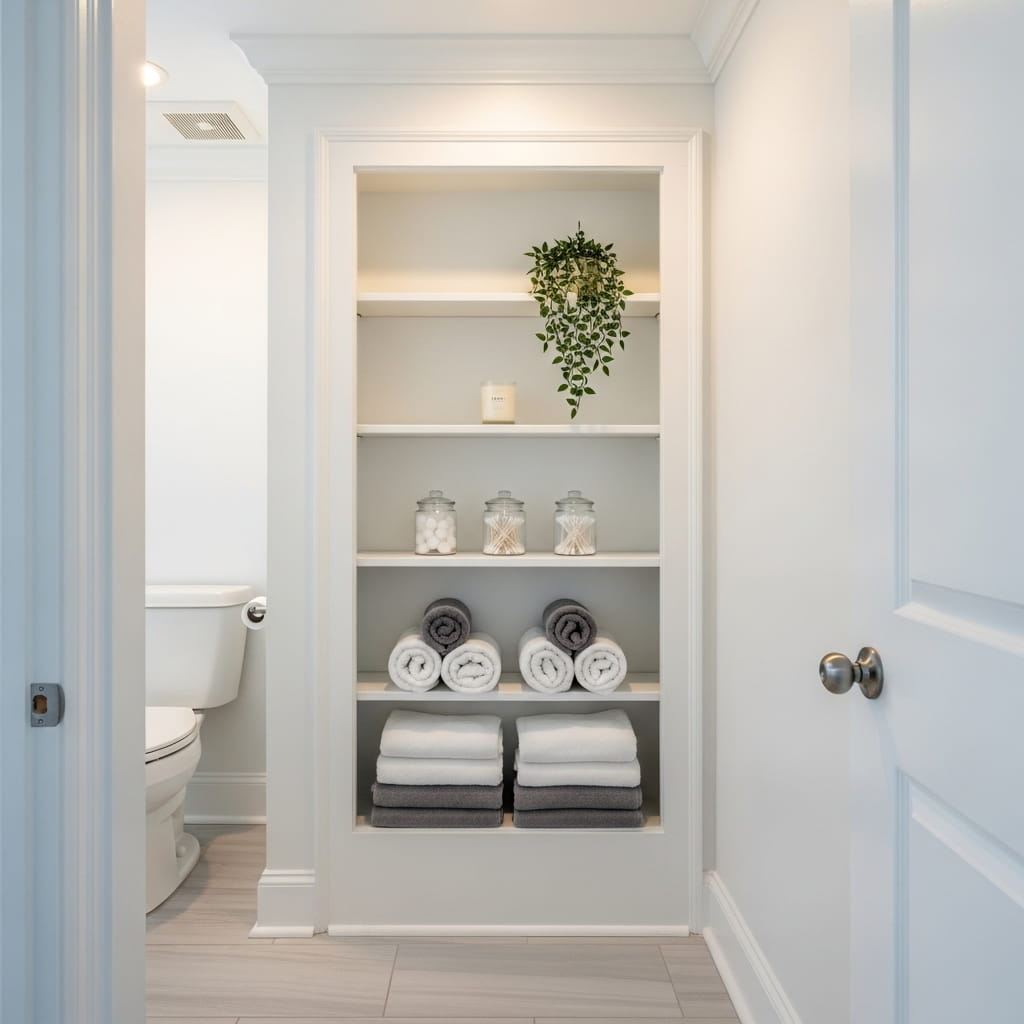
Built-in shelving recessed directly into the bathroom wall beside the toilet creates storage that occupies zero floor space and zero room depth, making it the most space-efficient bathroom storage solution available for compact bathroom layouts. A recessed shelf niche sits flush with the wall surface, which means the shelf itself does not project into the room at all. This built-in bathroom storage idea works especially well in the wall space above and beside the toilet , an area that most compact bathrooms leave completely unused.
Installing three to four recessed shelf levels at different heights in the toilet wall niche creates a complete storage tower for all bathroom essentials , rolled towels at the bottom, toiletry jars at the middle level, and decorative accessories at the top. The varying shelf heights allow you to store items of different sizes without wasting vertical space. That vertical storage stacking approach is one of the most practical recommendations bathroom designers give for maximizing storage in bathrooms under fifty square feet.
- Recessed shelves use zero floor or room depth space
- Built-in design looks clean and intentional
- Three shelf heights accommodate different item sizes
- Toilet wall niche uses typically wasted bathroom space
- Suits modern farmhouse and minimal bathroom styles
Styling the top shelf with a small trailing plant, a single white candle, and one small ceramic object creates a decorative vignette that makes the practical storage shelving feel curated and personal rather than purely utilitarian. That decorative top shelf signals to guests that the entire shelving unit is intentionally designed rather than simply functional. In my experience, adding one small decorative element to the top of a bathroom storage unit dramatically improves how the entire unit is perceived in the overall room design.
White paint on the built-in shelving unit and the surrounding wall area unifies the shelving structure with the bathroom walls, making the entire niche feel like an architectural feature rather than an afterthought addition. The white-on-white color continuity between shelf and wall allows the objects displayed on the shelves , the towels, the glass jars, the plant , to stand out clearly without any visual competition from the shelf structure itself. This monochromatic approach to built-in shelving keeps compact bathrooms feeling clean and spacious.
Freestanding Tub Corner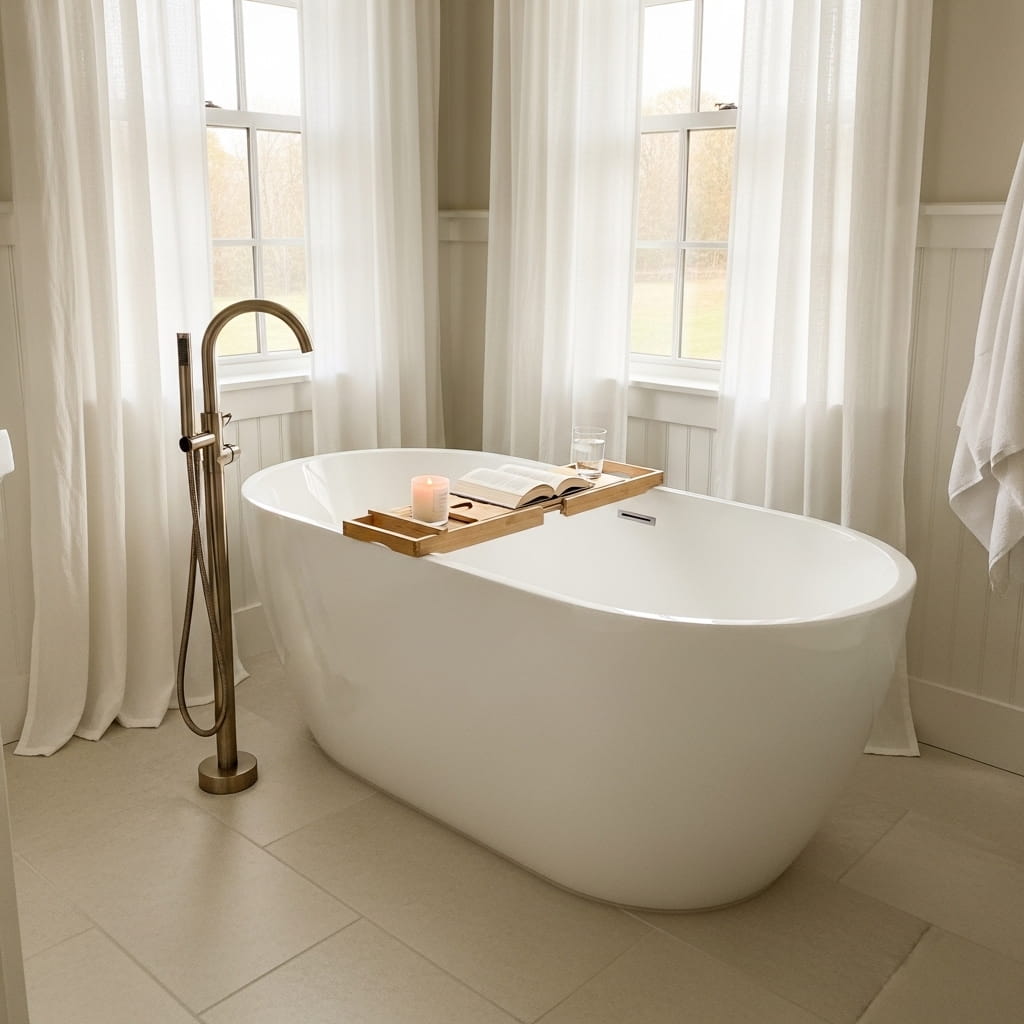
A compact freestanding soaking tub positioned in a bathroom corner delivers a spa-hotel luxury experience in a surprisingly small floor footprint. Modern freestanding tubs designed for compact bathrooms measure as small as fifty-four inches in length , short enough to fit comfortably in bathrooms as compact as fifty square feet when positioned in a corner against two walls. This bathroom layout idea proves that luxury and limited square footage are not mutually exclusive design goals.
Positioning the freestanding tub in a corner rather than centered against a single wall frees up the remaining floor area for a vanity, toilet, and movement space. The corner placement also uses the two intersecting walls as a natural backdrop frame for the tub, which makes the bathtub feel intentionally situated rather than crowded into the room. I’ve noticed that a freestanding tub in a corner with a large window beside it is the bathroom layout that receives the most Pinterest saves among all compact bathroom design options.
- Compact freestanding tubs start at 54 inches length
- Corner placement frees maximum remaining floor area
- Floor-mounted faucet suits freestanding tub styling
- Bath tray keeps tub surface styled and organized
- Most Pinterest-saved bathroom layout in 2026
A floor-mounted brushed gold faucet beside the freestanding tub adds a freestanding fixture detail that makes the bathtub area feel genuinely intentional and luxuriously considered. The tall floor faucet stands independently beside the tub without requiring any wall mounting, which suits corner tub placements where wall-mounted faucet access may be limited. The warm gold finish of the floor faucet connects naturally to warm-toned hardware throughout the rest of the bathroom design.
Sheer white linen curtains on the corner window beside the tub soften the morning light that fills the bathing area and add a romantic, gauzy quality to the tub vignette. The combination of warm natural light, sheer white fabric, pale cream tile, and the sculptural white oval tub creates a bathroom corner that looks and feels genuinely extraordinary , despite fitting within the footprint of a compact bathroom under sixty square feet.
Vintage Clawfoot Tub Style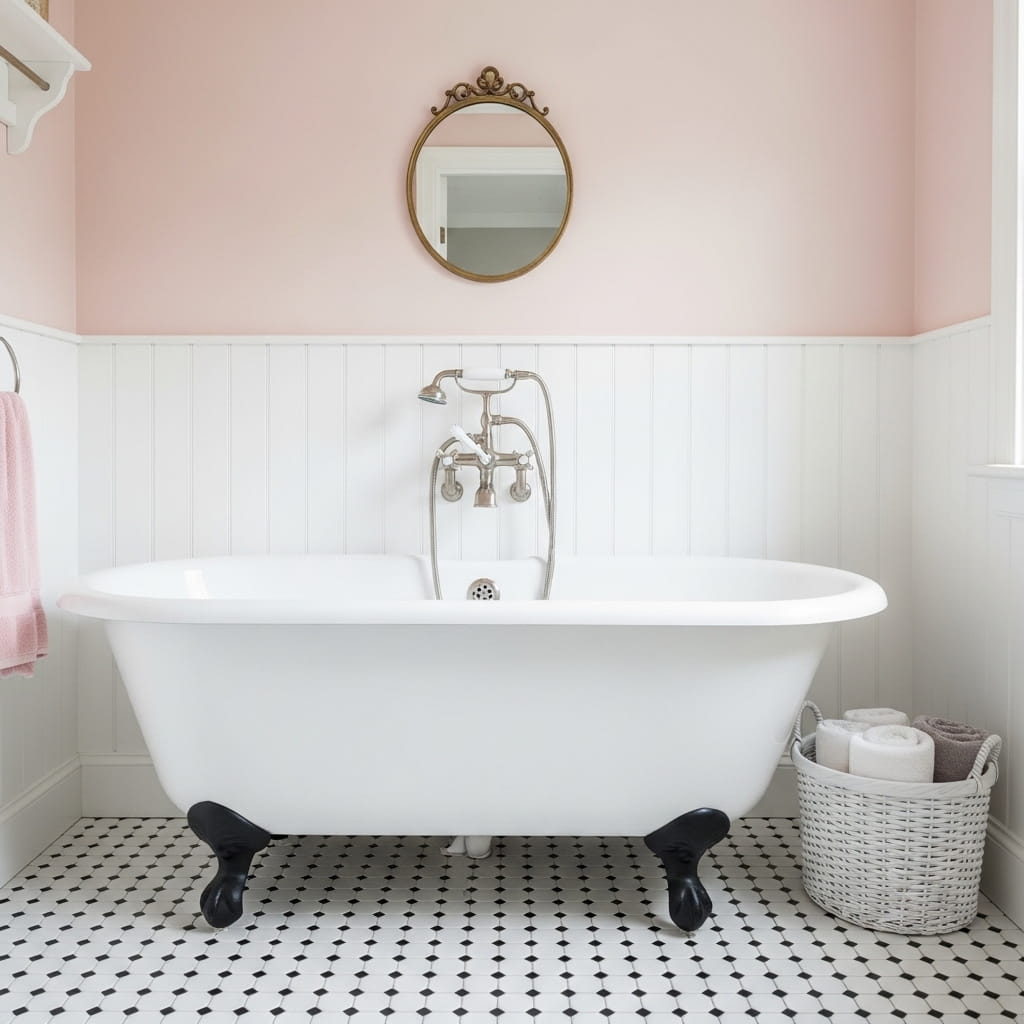
A white clawfoot bathtub on matte black claw feet brings instant vintage romance to any small bathroom, immediately transforming a functional bathing space into a characterful, story-rich room that feels collected and historically layered. The exposed claw feet elevate the tub off the floor on four distinctive sculptural legs, creating open floor visibility beneath the tub that makes the bathroom feel more spacious than an enclosed built-in tub would in the same footprint.
Pale blush pink upper walls paired with white shiplap paneling on the lower half create a warm, romantic wall treatment that suits the vintage clawfoot tub aesthetic with complete visual harmony. The shiplap panel detail adds horizontal texture at the lower wall zone while the soft blush paint above it introduces feminine warmth that amplifies the romantic character of the classic white tub. This bathroom wall combination is one of the most consistently pinned vintage bathroom styling choices in the USA market.
- Exposed claw feet create open floor visibility
- Blush pink walls add romantic vintage warmth
- White shiplap paneling adds lower wall texture
- Telephone-style shower attachment suits clawfoot tubs
- Black and white hex tile grounds the vintage aesthetic
A telephone-style shower attachment on the tub rim allows the clawfoot bath to function as a shower without any structural wall modifications, making it a genuinely practical vintage styling choice for bathrooms that need both bathing and shower functionality in one fixture. The brushed nickel telephone shower attachment suits the vintage character of the tub while maintaining a clean, contemporary finish that prevents the bathroom from looking like a museum exhibit.
Black and white hexagon mosaic floor tiles ground the vintage bathroom aesthetic with a classic, period-appropriate floor pattern that suits the clawfoot tub’s historical character without feeling overly themed. A white wicker basket beside the tub holding four rolled white towels adds practical storage at floor level while reinforcing the warm, cottage-style material palette of the overall bathroom design. This final wicker detail ties the organic, natural material story of the bathroom together at floor level.
Bamboo and Natural Linen Spa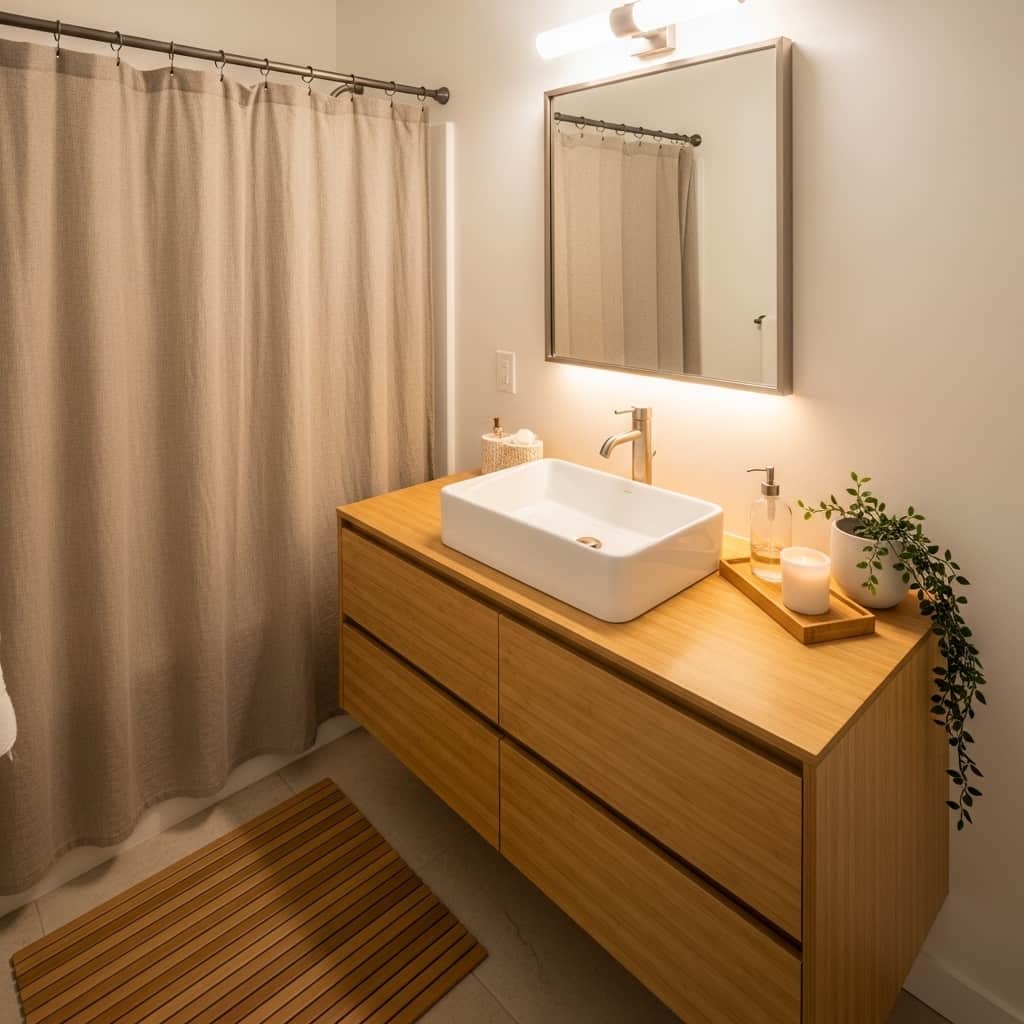
Bamboo and natural linen accessories in a compact bathroom create an instant zen, spa-like atmosphere that shifts the bathroom from a purely functional utility space into a genuine daily wellness sanctuary. The combination of bamboo’s warm golden wood tone, linen’s soft natural fabric texture, and potted green plant life creates a layered organic material palette that engages multiple senses simultaneously , sight, touch, and scent , making the bathroom experience feel deeply calming and restorative.
A natural linen shower curtain on a matte black rod suits compact bathrooms that use shower-tub combinations rather than enclosed glass showers because linen curtains add organic warmth and soft texture that standard plastic shower curtains simply cannot deliver. Linen hangs beautifully, develops a slight natural drape over time, and creates a soft, airy quality in the bathroom that feels spa-like even in a small, windowless space.
- Bamboo bath mat adds warm organic floor texture
- Natural linen curtain replaces clinical plastic alternative
- Bamboo vanity brings natural material warmth
- Trailing pothos adds living green spa-like quality
- Perfect for zen and wellness-inspired bathrooms
A bamboo wood tray on the vanity counter holding a glass soap dispenser and a single white pillar candle creates a clean, curated vanity vignette that reinforces the organic spa character of the bathroom without requiring any expensive accessories. The bamboo tray contains the small counter items into a defined, organized group that prevents the vanity surface from looking scattered. That tray-containment technique is one of the simplest and most effective bathroom styling methods recommended by interior organizers.
Warm LED strip lighting installed underneath the bamboo vanity casts a soft amber glow at floor level that creates a serene, lantern-like ambiance during evening bathroom use. The warm under-vanity light echoes the warm golden tone of the bamboo wood above it, creating a continuous warm glow from floor to counter level. This lighting detail costs under thirty dollars to install and delivers a spa hotel bathroom experience every single evening at home.
Wet Room Open Layout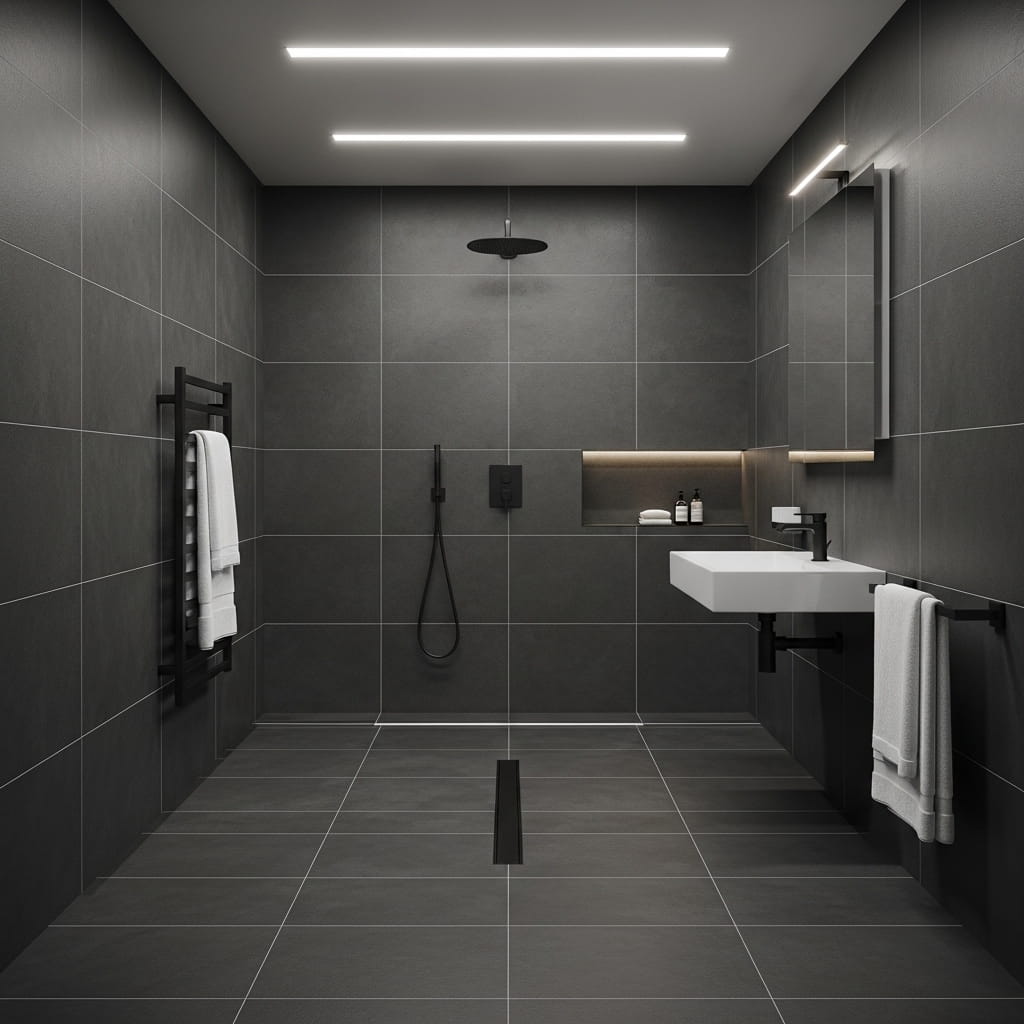
A wet room removes every barrier between the shower zone and the rest of the bathroom , no glass screen, no shower tray, no curtain , and instead waterproofs the entire room so the full floor space can function as the shower. This approach is one of the most space-maximizing bathroom layout ideas available for compact bathrooms because it eliminates the physical and visual boundaries that normally divide the room into smaller, more constricted zones.
Large format non-slip tiles covering the entire wet room floor and walls in one continuous material tone create a completely seamless visual field that makes the compact bathroom feel dramatically more expansive than its measured square footage. The absence of visual boundaries , no tile transitions, no shower tray edges, no glass panel , allows the eye to travel across every surface without interruption. That uninterrupted visual travel is what creates the powerful spatial illusion of a wet room design.
- No shower enclosure maximizes usable floor space
- Continuous tile removes all visual room boundaries
- Linear floor drain keeps wet room surface flush
- Wall-mounted fixtures free the floor completely
- Perfect for architectural and contemporary bathrooms
A central linear floor drain built flush with the tile surface keeps the wet room floor level and clean without any visible drainage fixture interrupting the seamless tile plane. The linear drain format suits the large format tile aesthetic of the wet room far better than a circular point drain, which would disrupt the clean horizontal lines of the tile surface. That flush, invisible drain detail is one of the key design elements that makes a wet room look truly architectural and professionally executed.
Wall-mounted toilet, sink, and towel rail all keep the wet room floor completely clear and unobstructed, which is essential for maintaining the wide-open floor plane that the wet room concept depends on for its spatial effectiveness. Every wall-mounted fixture in this bathroom layout elevates from the floor and creates visible space beneath it, contributing to the overall impression of a bathroom that is deliberately, purposefully open from wall to wall.
Statement Ceiling Tile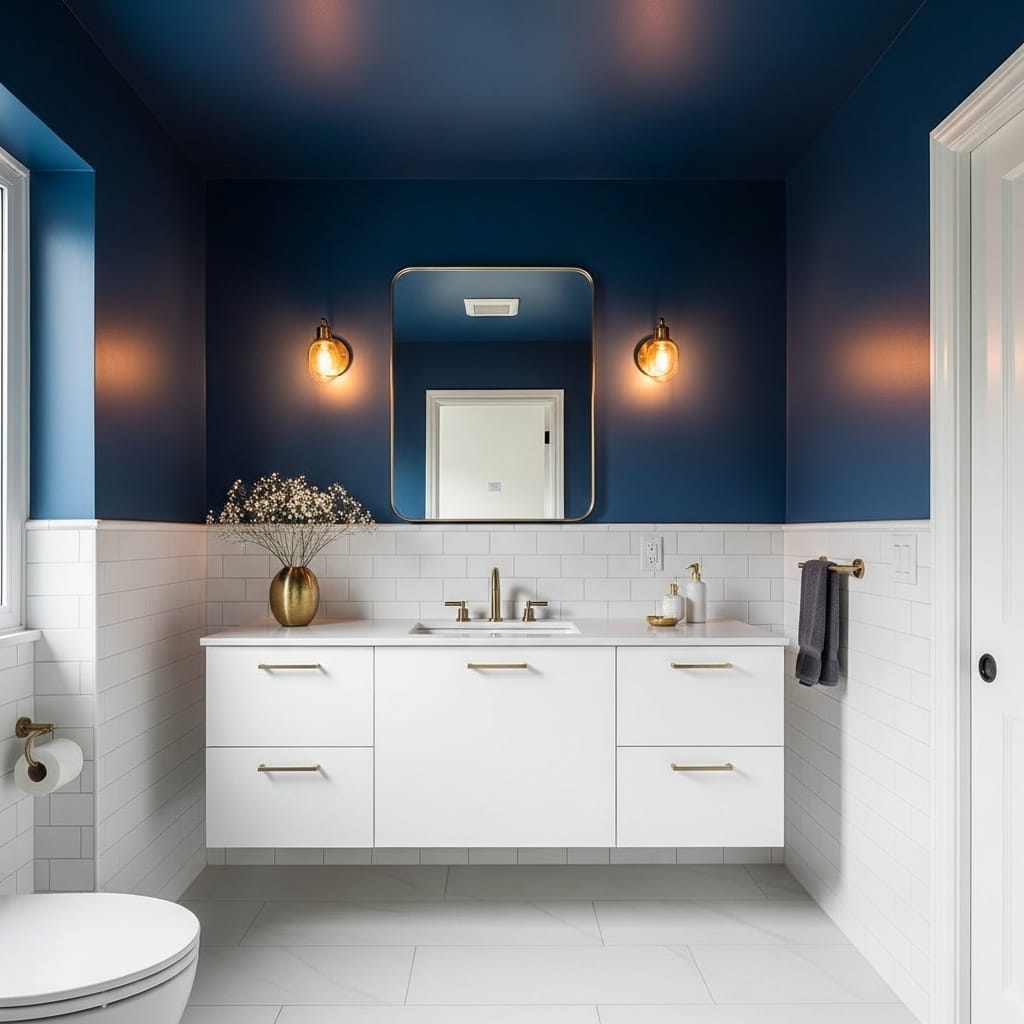
Painting the bathroom ceiling in a bold, deep color , navy, forest green, charcoal, or terracotta , is one of the most unexpected and visually dramatic small bathroom design ideas that requires zero renovation work and under fifty dollars in materials. The bold ceiling color draws the eye powerfully upward, which paradoxically makes the ceiling feel higher and the room feel taller than a standard white ceiling does. This compact bathroom styling technique is consistently one of the most surprising and effective design moves available.
A deep navy ceiling above white subway tile walls and white bathroom fixtures creates the maximum visual drama available from a paint-only bathroom update. The sharp contrast between the dark ceiling and the bright white walls below it makes both surfaces look more vivid and defined than either would in a single-tone bathroom. White tile walls look crisper and brighter against the navy above them, and the navy ceiling looks richer and deeper against the white surfaces surrounding it from below.
- Bold ceiling color draws the eye powerfully upward
- Dark ceiling above white walls creates vivid contrast
- Under fifty dollars for a complete ceiling transformation
- Warm sconce lighting activates the bold ceiling color
- Suits unexpected, architectural, and dramatic bathrooms
Warm amber wall sconces at eye level fill the dark navy ceiling space with warm upward-reaching light that makes the ceiling color glow rather than look flat and heavy. The amber light source below the ceiling boundary creates a warm halo effect that softens the dramatic ceiling color and makes the bathroom feel intimate rather than oppressive. I’ve seen this specific combination , dark ceiling, warm sconce light, white tile walls , receive more surprised positive reactions than almost any other affordable bathroom update.
Brushed gold hardware on the vanity and a thin brass mirror frame below the navy ceiling create a warm metallic accent line that visually separates the dramatic upper zone from the clean white lower zone. The gold and brass tones belong naturally to both the warm amber sconce light above and the warm white fixtures below, acting as a warm metallic bridge between the two very different color worlds of the ceiling and the walls.
Japandi Minimalist Bathroom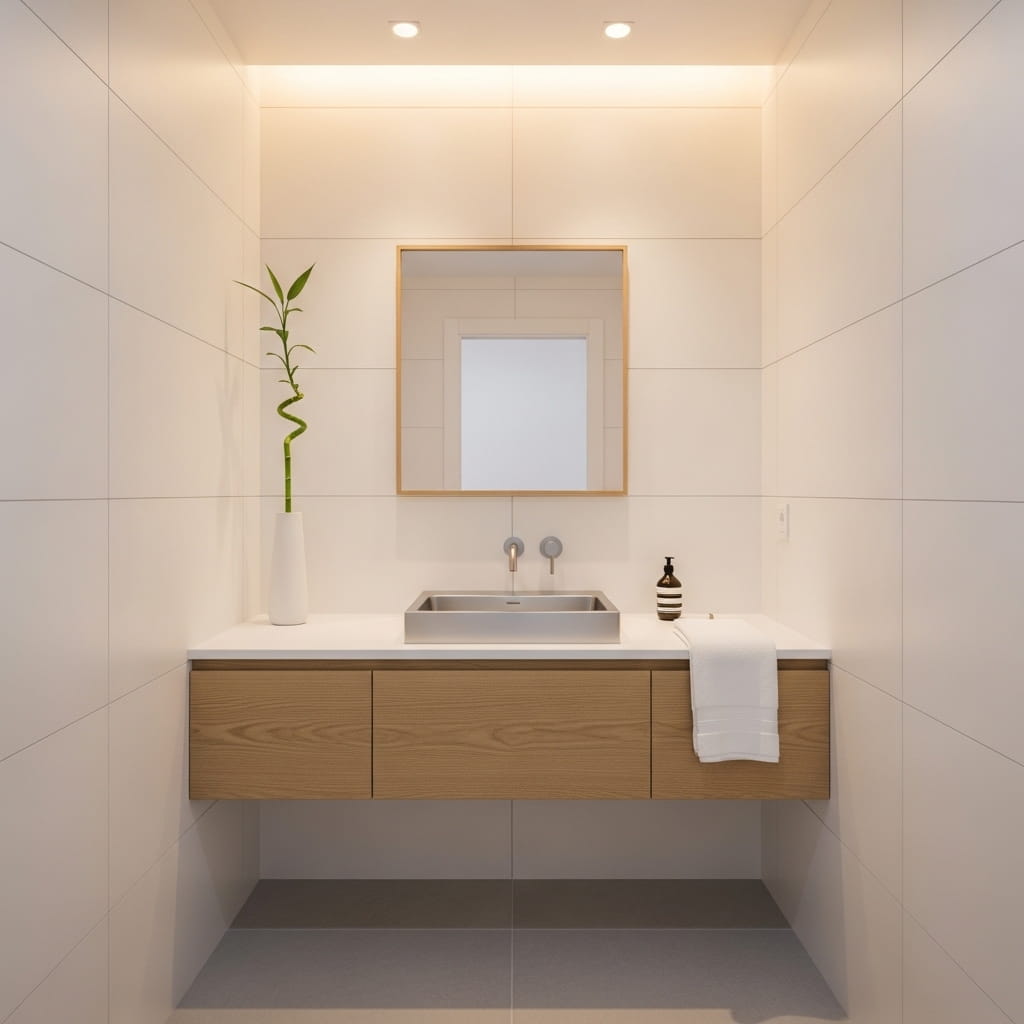
Japandi bathroom design combines Japanese minimalism’s deliberate restraint with Scandinavian warmth’s natural material comfort, creating a bathroom aesthetic that feels simultaneously bare and deeply welcoming. Every object in a Japandi bathroom earns its place , nothing is included for decoration alone, and every material choice reflects a genuine commitment to natural texture, calm color, and honest craftsmanship. This bathroom design approach suits people who want their morning and evening routines to feel genuinely grounding and restorative.
Natural light oak wood for the floating vanity brings Scandinavian warmth to the Japandi bathroom while the white matte tile walls and pale gray floor deliver the clean, unadorned Japanese minimalism that anchors the design. Those two cultural design languages , one warm and wood-focused, one restrained and surface-focused , sit together in a balance that neither direction achieves alone. That tension between warmth and restraint is the defining quality that makes Japandi bathroom design so compelling and liveable.
- Every object in Japandi design earns its place
- Light oak vanity delivers Scandinavian warmth
- White matte tiles provide Japanese surface restraint
- Single bamboo stem adds organic Japanese character
- Suits calm, minimal, and wellness-focused bathrooms
A single bamboo stem in a tall white ceramic vase placed at the corner of the vanity counter introduces the organic Japanese botanical aesthetic without adding visual clutter. The tall, spare bamboo form suits the Japandi preference for natural materials that are present in small, deliberate quantities rather than abundant decorative displays. That restrained use of botanical material , one stem, one vessel , is one of the most recognizable Japandi styling signatures in both Japanese and Scandinavian interior design traditions.
A square frameless mirror mounted flush with the tile wall surface , with no frame, no visible mounting hardware , maintains the clean, uninterrupted tile plane of the Japandi bathroom wall. The frameless flush mirror looks like a window cut directly into the tile surface, which suits the Japandi commitment to visual simplicity at every surface. Warm soft recessed LED lighting keeps the ceiling surface equally clean and uninterrupted, reinforcing the spare, purposeful aesthetic throughout the entire bathroom space.
Maximalist Tile Mix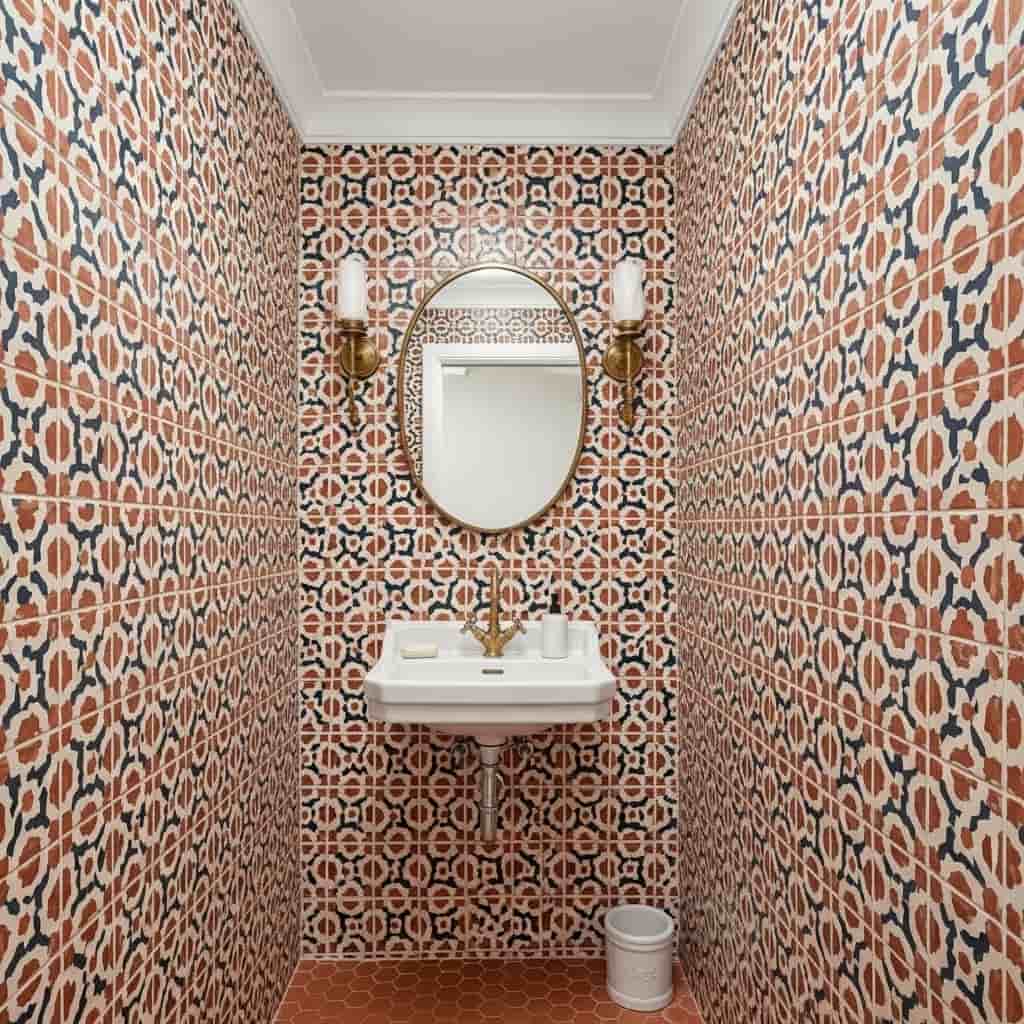
Covering all four walls of a compact bathroom in bold Moroccan-pattern encaustic cement tiles creates the most richly maximalist small bathroom transformation on this entire list. The Moroccan geometric pattern in terracotta, navy, and cream on every wall creates a fully immersive, jewel-box atmosphere that makes the bathroom feel like a transportive design destination rather than a functional utility room. Small bathrooms are genuinely the perfect canvas for this all-over pattern approach because the limited wall area prevents the bold tile from becoming visually overwhelming.
Encaustic cement tiles have a naturally matte, slightly porous surface that absorbs light rather than reflecting it, which gives the patterned bathroom a rich, warm depth rather than the cold, shiny surface quality of glazed ceramic tiles. That light-absorbing matte surface quality suits the warm terracotta and navy color palette of Moroccan geometric patterns particularly well because both colors look richer and more saturated on a matte surface than on a reflective glaze.
- All-over Moroccan pattern creates jewel-box immersion
- Encaustic matte surface makes colors look richer
- Small rooms make bold all-over pattern feel contained
- Aged brass hardware suits Moroccan tile warmth
- Suits maximalist, Moroccan, and eclectic bathrooms
Aged brass hardware , faucet, mirror frame, and wall sconce , suits the warm terracotta and navy Moroccan tile palette with natural cultural authenticity. Brass and aged bronze finishes belong to the traditional material language of Moroccan interior design, where warm hammered metals appear alongside rich ceramic tilework as complementary materials. That hardware-to-tile cultural alignment makes the aged brass fixtures feel completely resolved and intentional within the overall maximalist design story.
A white ceiling above the pattern-covered walls provides an essential visual breathing space that prevents the maximalist tile bathroom from feeling cave-like or claustrophobic. The white ceiling acts as a clean, neutral cap above the pattern-saturated walls that gives the eye a resting point while the bold tile below it commands complete visual attention. That white ceiling above bold patterned walls is the single most important rule for achieving successful maximalist tile bathrooms in compact spaces.
Industrial Pipe Shelving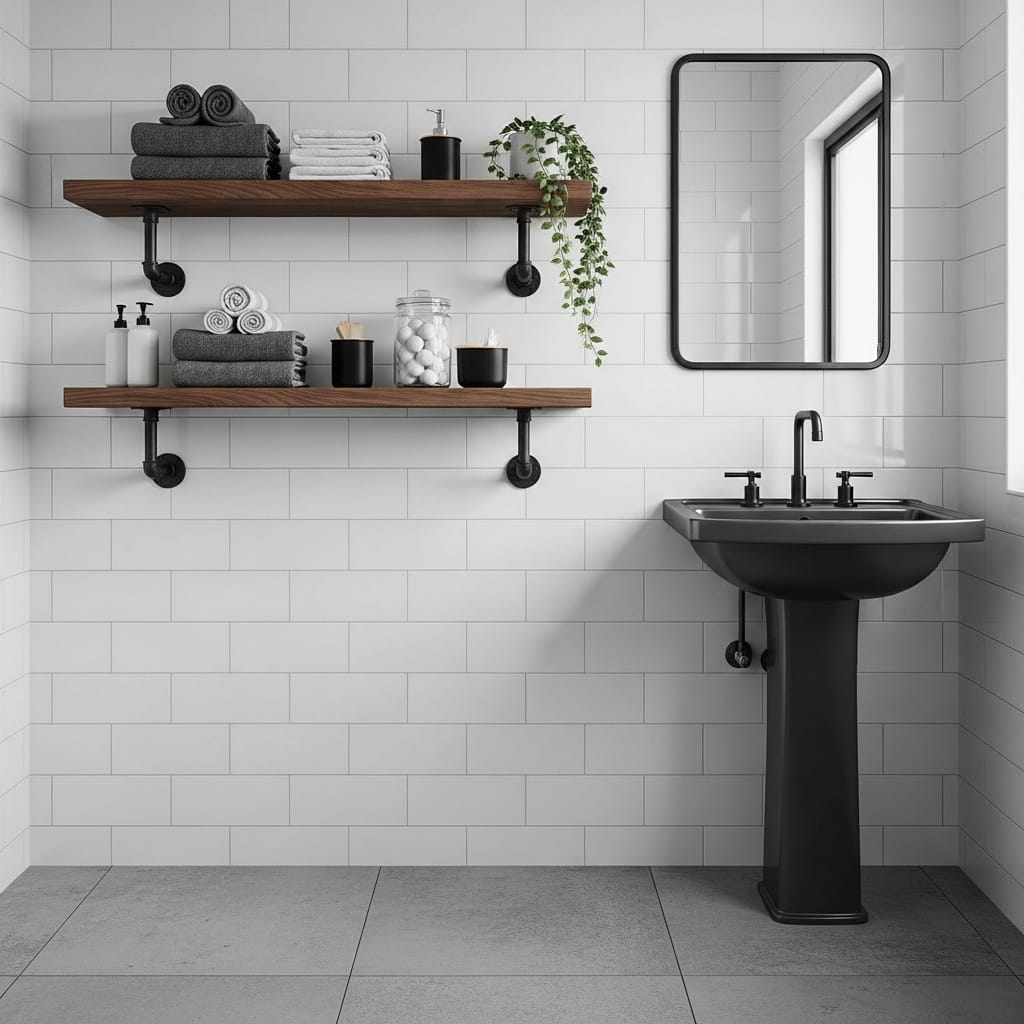
Exposed black iron pipe shelving brackets supporting reclaimed wood shelves on a bathroom wall create an industrial-chic storage solution that adds raw, urban character to a compact bathroom without any built-in construction or permanent structural modification. The combination of black iron pipe, dark walnut wood, and white subway tile delivers a three-material industrial palette that suits loft apartments, urban homes, and contemporary bathrooms with equal visual confidence.
Reclaimed dark walnut wood shelf boards add warmth and organic texture that prevents the industrial pipe shelving from feeling cold or purely mechanical. The warm brown wood grain softens the hard black iron bracket in exactly the way that industrial-chic design requires , one warm natural material balancing one cool industrial material at every visual junction. That warm-and-cool material pairing is the core design principle behind every successful industrial interior, from large loft spaces down to compact bathroom shelving.
- Black iron pipe brackets add raw industrial character
- Reclaimed wood shelves soften the industrial aesthetic
- No built-in construction required for installation
- Three-material palette suits urban and loft bathrooms
- Suits industrial, contemporary, and eclectic bathrooms
Matte black plumbing fixtures , pedestal sink, exposed pipe faucet, and towel ring , throughout the bathroom create a consistent industrial hardware palette that connects every metallic element in the room to the same matte black pipe shelving brackets on the wall. That full-room matte black hardware consistency makes the entire industrial bathroom design feel cohesive and intentionally curated rather than casually assembled from separate purchase decisions.
Concrete-look large format porcelain floor tiles complete the industrial material palette at floor level by adding a cool, mineral-toned surface that belongs naturally to the raw, urban character of the overall bathroom design. The concrete floor texture references industrial warehouse floors and urban loft aesthetics that the iron pipe shelving and matte black fixtures establish above. That material consistency from the floor through the shelving hardware creates a fully resolved industrial bathroom design from every viewing angle.
Painted Brick Accent Wall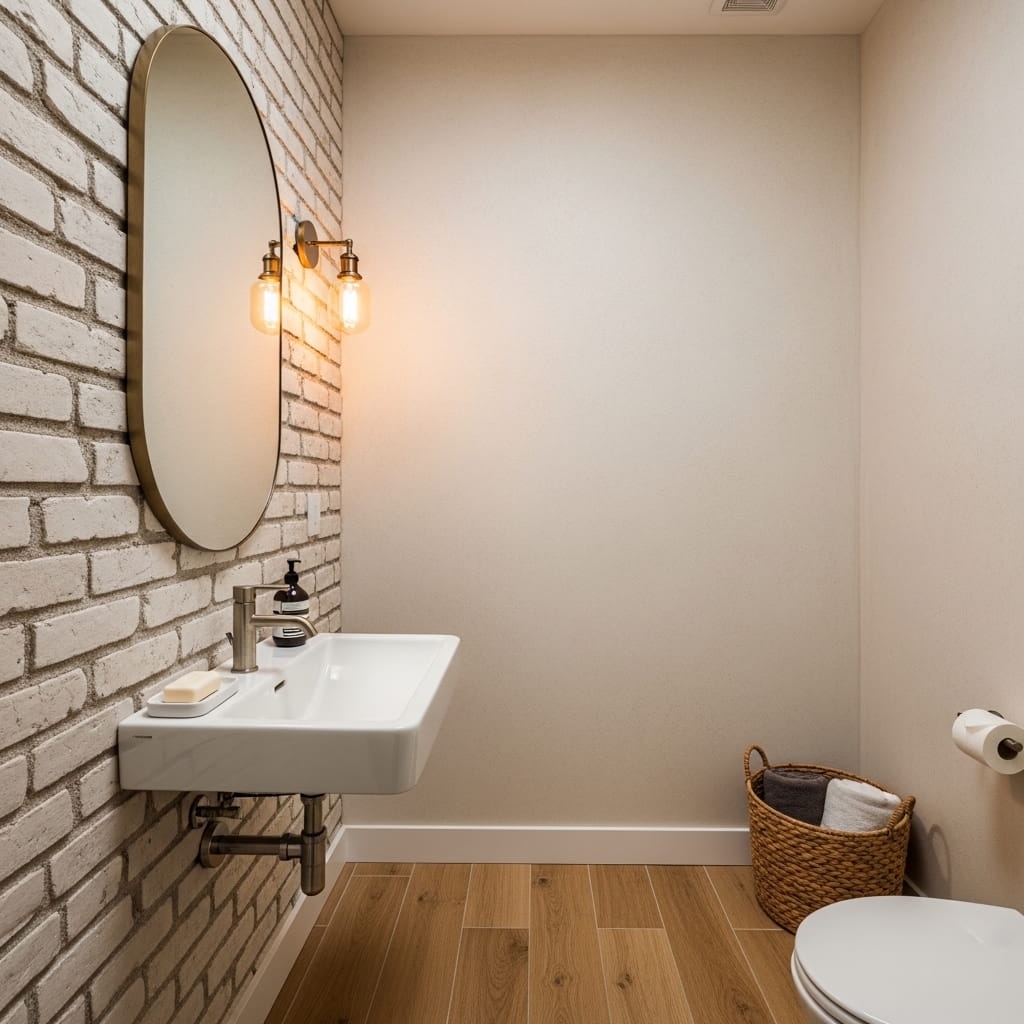
A single white-painted exposed brick wall behind the bathroom sink creates an instant architectural character feature that makes a compact bathroom feel rich with history and personality. White paint on the brick softens the raw industrial quality of the exposed brick and creates a warm, textural backdrop that suits vintage, farmhouse, and warm contemporary bathroom aesthetics equally well. The brick texture remains fully visible beneath the white paint, providing a tactile, three-dimensional wall surface that flat painted or tiled walls simply cannot replicate.
Exposed brick has a natural thermal quality that makes the bathroom feel warm and enveloping, especially when paired with warm amber lighting and honey oak floor tiles. The rough, porous brick surface absorbs warm light from the Edison sconce beside it and returns that light as a soft, diffused amber glow that fills the bathroom corner with intimate warmth. That light-absorbing quality of painted brick creates a bathroom atmosphere that feels genuinely different from any tile or painted wall surface.
- White painted brick adds textural architectural character
- Brick surface absorbs and diffuses warm light beautifully
- Single brick wall suits vintage and farmhouse bathrooms
- Brass hardware connects naturally to warm brick tones
- Rental-friendly with removable brick-effect wallpaper options
Brushed brass faucet, oval brass mirror frame, and warm amber Edison bulb sconce create a warm metallic and light theme that connects naturally to the honey and cream tones in the white-painted brick surface. The warm brass finish echoes the warm yellow-orange undertones that natural brick carries beneath white paint, creating a color family relationship between the hardware and the wall that makes both feel genuinely complementary.
Honey oak wide plank floor tiles ground the warm brick-and-brass bathroom palette at floor level with a third warm natural material that amplifies the overall earthy, organic character of the design. A woven rattan basket beside the toilet holds three rolled towels and adds a fourth natural material , woven plant fiber , that completes the warm organic material story from floor level upward. This material layering approach , brick, brass, oak, and rattan , creates a bathroom with extraordinary warmth and depth.
Corner Vanity Placement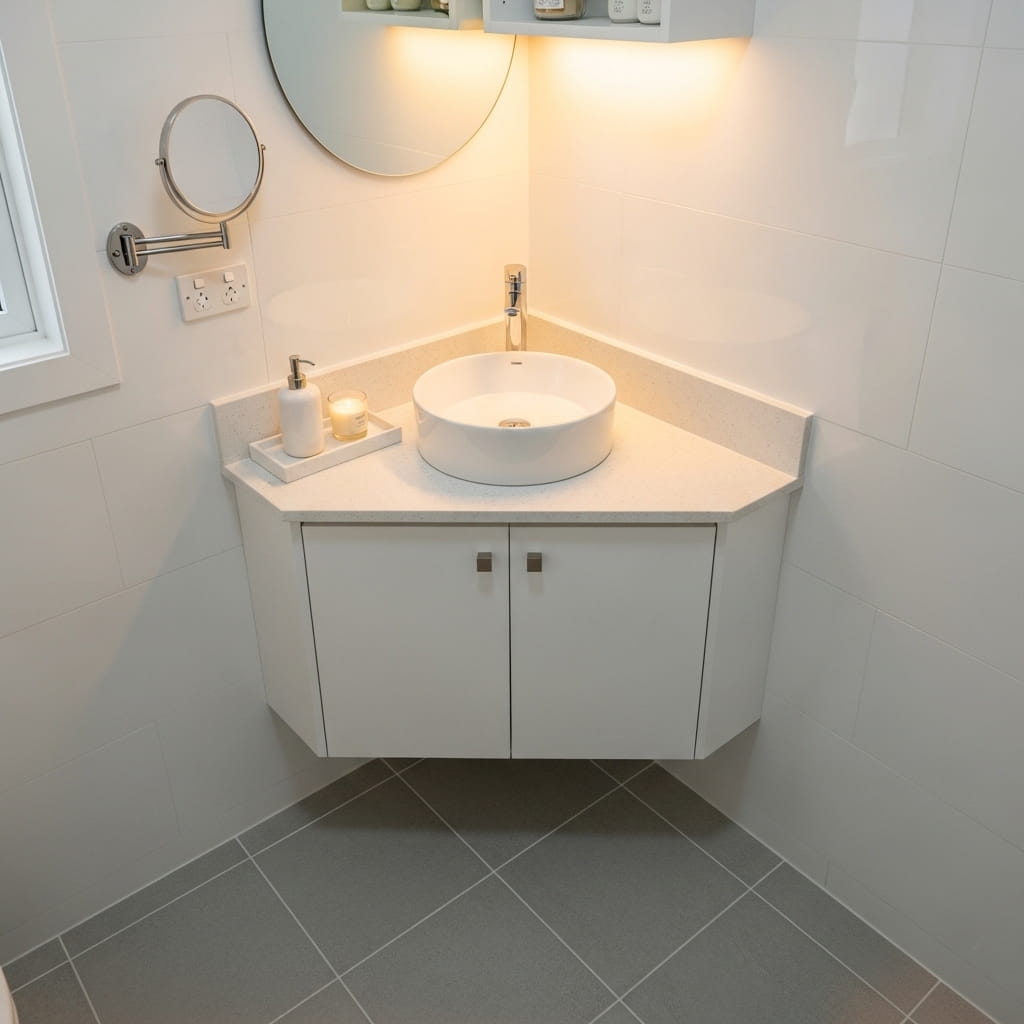
A corner vanity fitted diagonally into the bathroom corner is one of the most space-intelligent sink placement decisions available for compact bathrooms that struggle with layout constraints. Diagonal corner vanities occupy the one area of the bathroom that standard furniture placement consistently ignores , the corner , and turn it into a fully functional sink zone without consuming any linear wall space on either adjacent wall. This compact bathroom layout idea suits bathrooms under forty square feet where every inch of linear wall space is needed for the toilet, shower, and door clearance.
The triangular footprint of a diagonal corner vanity leaves both adjacent walls completely free for towel rails, shelving, or mirrors, which gives the bathroom designer significantly more wall surface to work with than a standard front-facing vanity allows. I’ve seen a corner vanity placement completely resolve a bathroom layout that seemed impossible to furnish comfortably , freeing enough linear wall space on both sides to add a full shower and a storage shelf that the previous layout simply could not accommodate.
- Corner placement frees both adjacent walls completely
- Diagonal footprint suits bathrooms under 40 square feet
- Circular mirror suits the compact corner vanity scale
- Maximizes usable wall space for shower and storage
- One of the smartest small bathroom layout solutions
A small circular mirror on the wall directly above the corner vanity suits the compact, rounded aesthetic of the corner sink unit far better than a large rectangular mirror would. The circular form echoes the round undermount sink basin and creates a visual rhyme between the mirror shape and the sink shape that makes the corner vanity area feel deliberately designed and internally consistent. Small circular mirrors also occupy minimal wall area, which preserves the open wall space on either side of the corner for towel hooks or shelving.
Light gray large format floor tiles running continuously from the bathroom entrance across the corner vanity zone create a seamless floor surface that visually unifies the diagonal vanity placement with the rest of the bathroom. The large format tiles minimize grout line frequency and allow the floor to read as a single uninterrupted plane that makes the compact bathroom feel cleaner and more spacious. That visual floor continuity is particularly important in a corner vanity bathroom where diagonal placement could otherwise create a visually disjointed layout.
Sage Painted Shiplap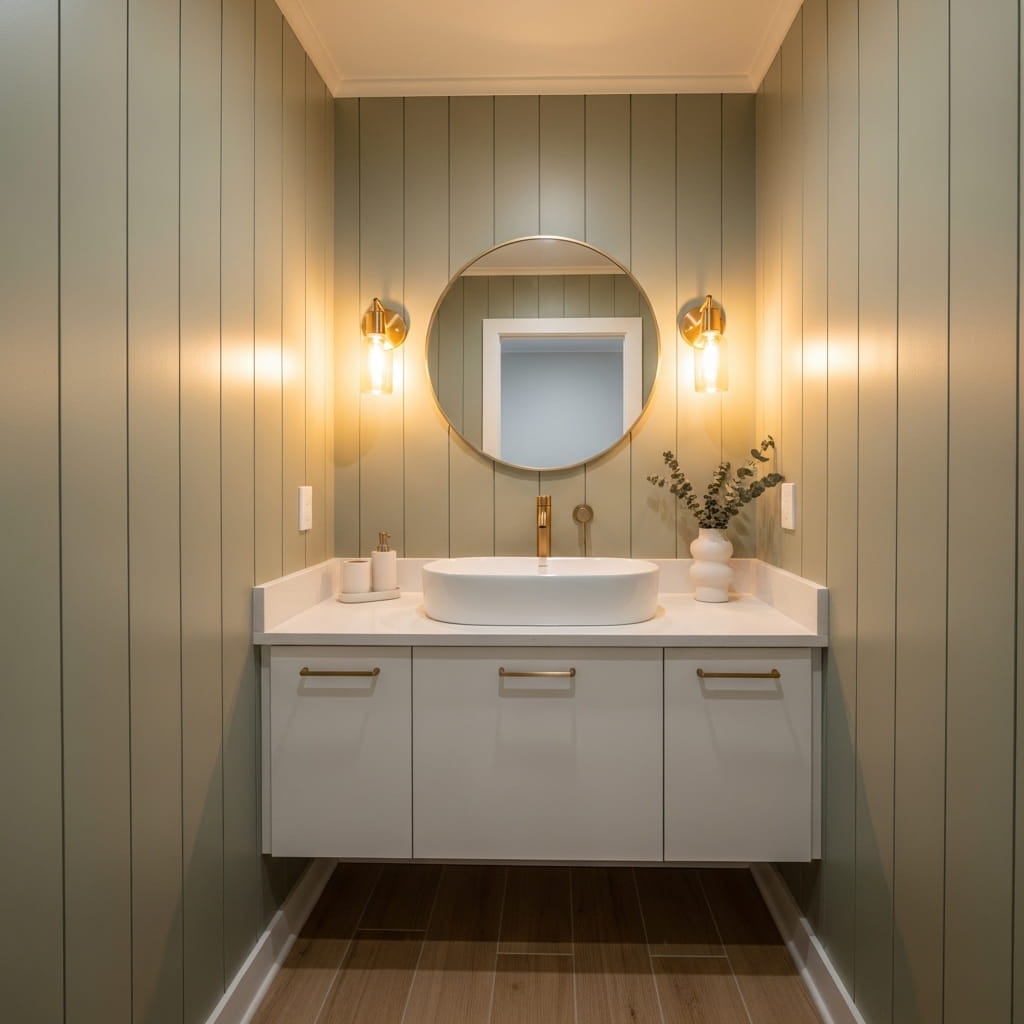
Sage green painted shiplap covering all four bathroom walls from floor to ceiling creates an enveloping, warmly organic bathroom atmosphere that feels like stepping into a botanical sanctuary. The continuous sage green shiplap surface wraps the entire room in one cohesive organic color while the vertical wood panel lines add texture and subtle height-enhancing direction to every wall simultaneously. This combination of sage green paint, vertical shiplap texture, and white fixtures creates one of the most photographed small bathroom design ideas across USA home decor platforms in 2026.
Applying the same sage green shiplap color to all four walls , rather than one feature wall , creates an immersive tonal environment where the color surrounds you completely and creates a botanical, enveloping quality that a single accent wall simply cannot achieve. The all-wall application transforms the bathroom from a room with a decorated wall to a room that is itself a cohesive design statement. That immersive quality is what gives sage green all-wall shiplap bathrooms their distinctive, deeply inviting atmosphere.
- All-wall sage green creates botanical immersive warmth
- Vertical shiplap lines add height to the room
- White fixtures pop cleanly against sage green backdrop
- Brushed gold hardware amplifies the sage warmth
- Perfect for modern farmhouse and organic bathrooms
Brushed gold hardware , faucet, mirror frame, and wall sconces , amplifies the warm earthy quality of the sage green shiplap and creates a warm metallic thread that runs continuously across the full bathroom design. The gold tone connects naturally to the warm amber bulbs in the wall sconces, which fill the sage green walls with a soft, honey-colored glow during evening bathroom use. That warm amber light on sage green walls creates the coziest, most inviting small bathroom atmosphere possible.
Dried eucalyptus in a small white ceramic vase on the vanity counter adds a living botanical reference that connects the sage green wall color to actual plant life in the most natural and authentic way. The silver-green eucalyptus tone sits naturally against the muted sage green shiplap behind it and adds a gentle aromatic quality to the bathroom that reinforces the botanical, spa-like atmosphere. Light oak floor tiles ground the full sage green room with a warm natural wood tone that prevents the all-green walls from feeling heavy or enclosed.
Lighted Mirror Cabinet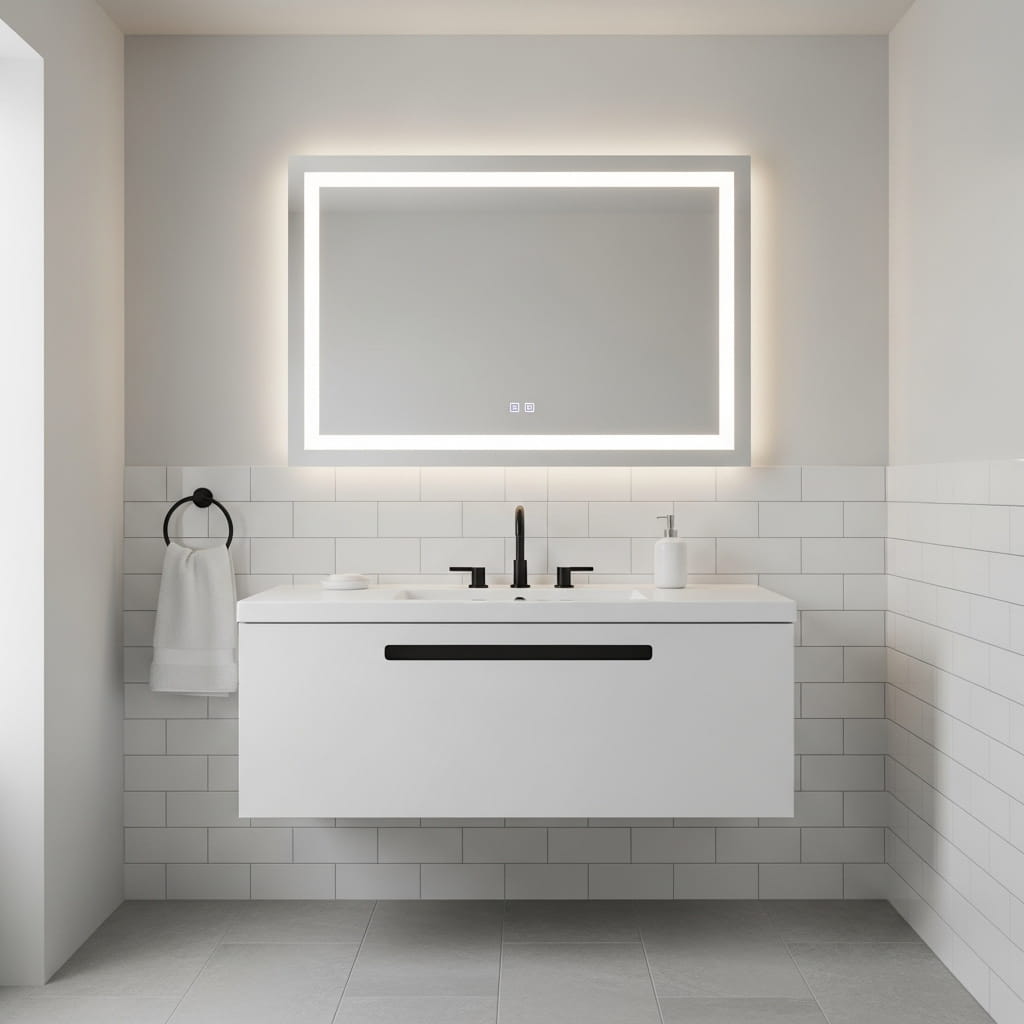
A recessed LED lighted mirror medicine cabinet solves three small bathroom problems simultaneously , storage, lighting, and mirror , in a single wall-mounted fixture that occupies zero counter space and zero floor space. The medicine cabinet recess sits inside the wall cavity, meaning the entire cabinet projects zero depth into the bathroom room. The built-in LED light ring around the mirror face provides even, flattering vanity lighting without any additional sconce fixture on the wall. This three-in-one bathroom fixture is one of the most practical small bathroom storage ideas available for compact modern bathrooms.
The LED light perimeter on a lighted mirror cabinet provides dramatically superior vanity lighting compared to a single overhead fixture because the light source surrounds the mirror face at eye level rather than casting downward from above. Light at eye level eliminates the harsh shadows that overhead lighting creates on the face and provides the most accurate, evenly lit reflection for morning grooming routines. That’s why many bathroom designers and lighting specialists describe the lighted mirror cabinet as the first upgrade they recommend for any compact bathroom renovation.
- Three-in-one solution combines mirror, storage, and light
- Recessed design adds zero depth to the bathroom
- LED perimeter provides superior eye-level lighting
- Medicine cabinet hides toiletries behind mirror face
- Most practical single fixture for small bathroom upgrades
The medicine cabinet interior behind the mirror face holds a full week’s supply of toiletries, medications, and grooming products neatly organized on three to four adjustable shelves. Every item hidden inside the medicine cabinet is one less item cluttering the vanity counter surface below it, which keeps the vanity top clean, minimal, and free for the one or two accessories that genuinely belong on display. That counter-clearing quality of the medicine cabinet is what makes it such a consistently high-value small bathroom organization investment.
Matte black hardware , faucet, towel ring, and cabinet handle , throughout the bathroom connects the medicine cabinet’s contemporary aesthetic to the rest of the bathroom design through a consistent metallic language. The matte black finish suits the clean, contemporary character of the LED lighted mirror cabinet and prevents the bathroom from looking like a showroom display of unrelated fixtures. That full-room hardware consistency from the cabinet handle down to the faucet and towel ring is what makes a small bathroom design feel professionally resolved.
Herringbone Shower Floor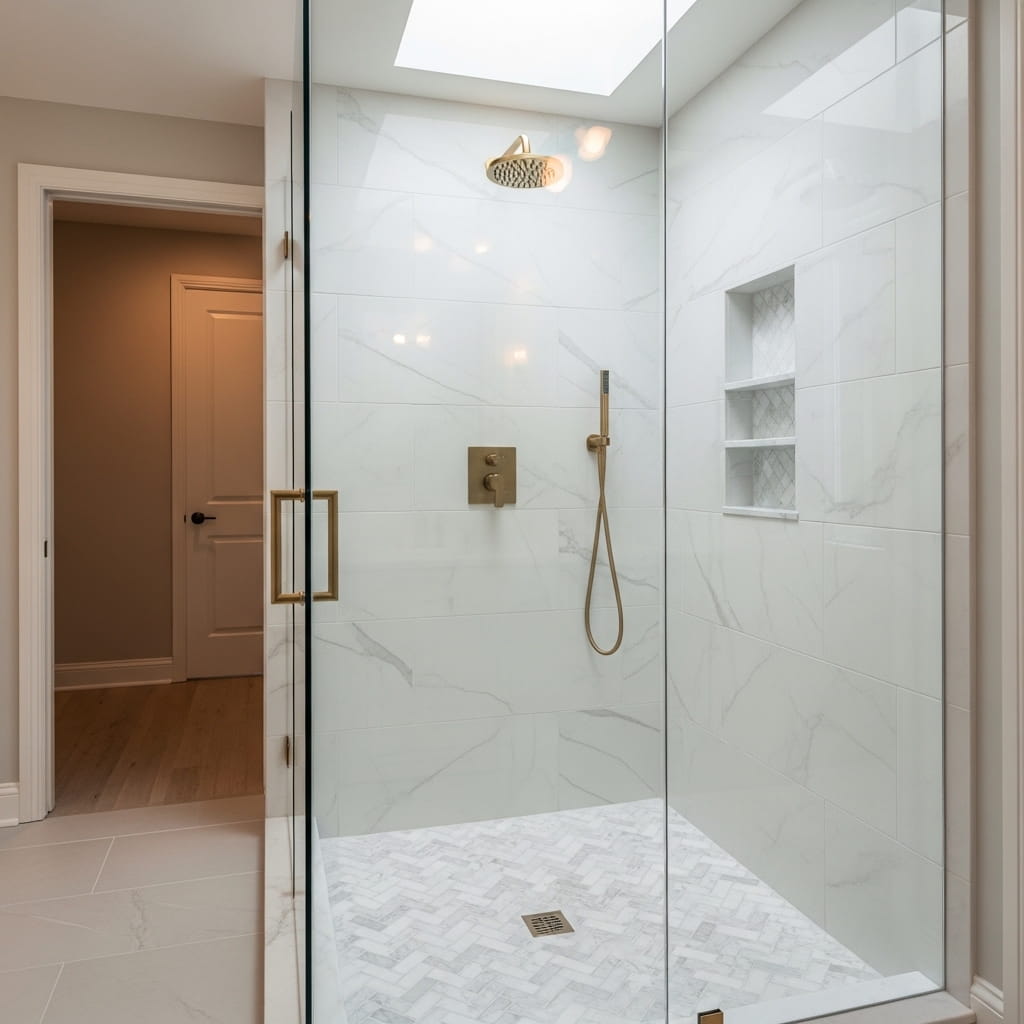
A white marble herringbone pattern on the shower floor creates the most classically luxurious detail available within a compact shower space without requiring a full marble tile bathroom renovation. The herringbone arrangement of the small marble tiles adds a directional, dynamic visual energy at floor level that draws the eye toward the shower space and establishes the shower floor as a deliberate design feature rather than a purely functional surface. This bathroom design detail suits classic, transitional, luxury, and romantic bathroom aesthetics with remarkable visual confidence.
The herringbone tile pattern’s angled directional layout creates an optical widening effect at floor level that makes a compact shower floor feel more expansive than a standard straight-set tile of the same size would in the same space. The angled tile joints direct the eye diagonally across the floor surface rather than straight across, which creates a wider perceived dimension than the actual measured dimension. I’ve noticed that herringbone shower floors consistently appear in the top ten most-saved bathroom detail images across USA Pinterest home decor boards.
- Herringbone pattern adds directional visual energy
- Angled layout makes shower floor feel wider
- White marble tile creates classic luxury shower detail
- Brushed gold fixtures suit marble beautifully
- Perfect for classic, transitional, and luxury bathrooms
Brushed gold rain showerhead and thermostatic valve on the white marble-look shower wall add warm luxury hardware accents that belong naturally to the classic marble material aesthetic. The warm gold finish connects to the natural warm veining tones present in white marble tile, creating a hardware-to-material color relationship that makes the shower design feel precisely calibrated. A small marble-interior built-in niche shelf adds a third marble detail at mid-wall height that reinforces the luxury material story within the compact shower space.
Natural light from a frosted skylight above the shower fills the marble herringbone floor with a soft, natural overhead illumination that activates every crystal and vein in the marble surface. Skylights above showers are one of the most coveted but least common bathroom design features in USA compact bathroom renovations, which is precisely why they generate such strong emotional responses and Pinterest save rates when photographed. The combination of natural skylight, marble herringbone floor, and brushed gold hardware creates a shower that photographs as genuinely extraordinary.
Vintage Blue Vanity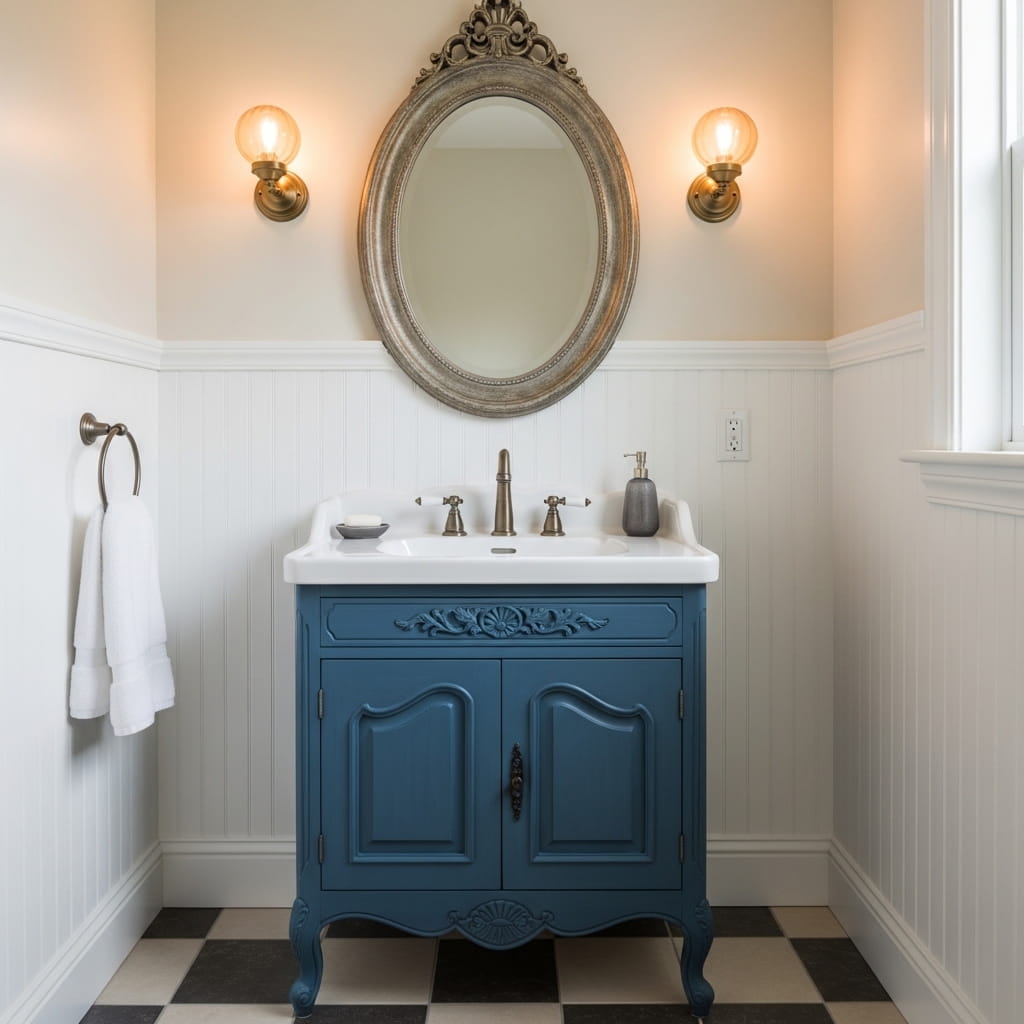
A deep vintage blue painted vanity cabinet with ornate carved door detail immediately transforms a compact bathroom into a character-rich, vintage-inspired space that feels collected from a decades-old European estate rather than purchased from a modern home goods store. The ornate carved door detail on the vintage blue cabinet adds a three-dimensional craftsmanship quality to the bathroom design that flat-front contemporary cabinetry simply cannot replicate. This bathroom design idea suits vintage, romantic, and maximalist-lite bathroom aesthetics with outstanding personality.
Deep vintage blue , a blue-gray tone with a slight dusty, aged quality , differs from standard navy or cobalt in its muted, heritage character that reads as genuinely aged and historically inspired rather than simply dark. The dusty, muted quality of vintage blue suits aged brass and antique gold hardware finishes far better than bright, saturated blue would, creating a color-and-hardware relationship that feels authentically old rather than trendy-new. That vintage material coherence is what makes this bathroom design feel genuinely characterful.
- Ornate carved cabinet detail adds artisan craftsmanship
- Vintage blue reads as aged and heritage-inspired
- Aged brass hardware suits vintage blue beautifully
- Beadboard lower paneling reinforces vintage character
- Suits vintage, romantic, and character-rich bathrooms
White beadboard paneling on the lower half of the bathroom walls reinforces the vintage character of the blue vanity cabinet by adding a second period-appropriate architectural detail to the bathroom design. Beadboard paneling suits vintage bathrooms because it references the wall treatment found in early twentieth-century American homes, where beadboard was a common and practical lower wall material. The combination of ornate blue cabinet, beadboard paneling, and checkered floor creates a fully immersive vintage bathroom environment.
Black and cream checkered floor tiles add a final vintage graphic detail at floor level that grounds the character-rich bathroom design with a bold, period-appropriate pattern. The checkered tile’s black and cream color palette suits the cream upper walls and the white beadboard paneling while providing a strong graphic contrast to the deep vintage blue vanity above it. That bold floor-to-cabinet color contrast , deep vintage blue above, crisp black and cream below , creates a complete and confident vintage bathroom design story.
Mirror Wall Illusion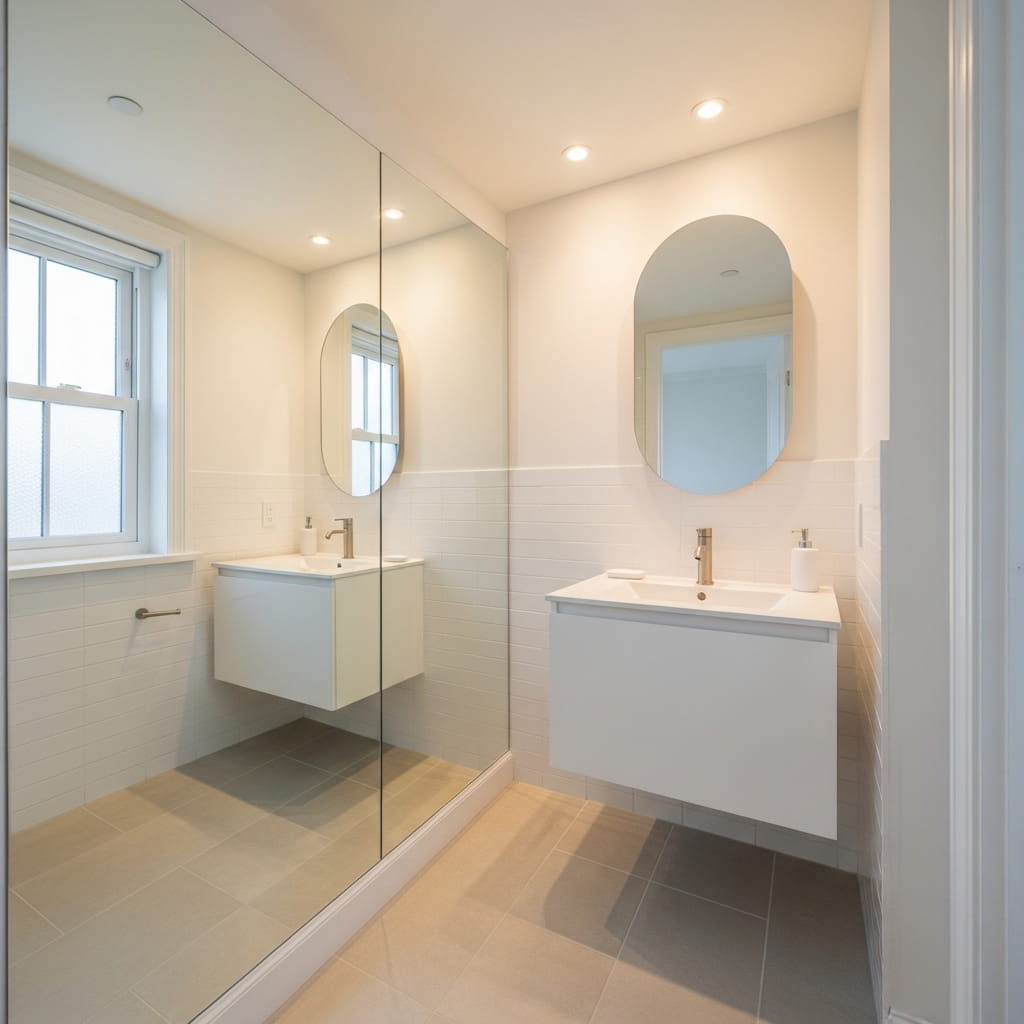
A full floor-to-ceiling mirror panel covering one complete bathroom wall is the most powerful space-doubling illusion available in compact bathroom design. The full-wall mirror reflects the entire bathroom layout back into itself, creating the visual impression of a room twice the actual size with a duplicate bathroom extending behind the mirror surface. This bathroom styling technique suits any bathroom aesthetic because the mirror itself is neutral , it reflects and amplifies whatever design exists in the actual bathroom space.
Positioning the full-wall mirror on the wall directly opposite the bathroom window is the most strategically effective placement because the mirror reflects the window’s natural light back across the entire bathroom. That natural light reflection fills the bathroom with twice the amount of daylight that the window alone would provide, making the room feel simultaneously larger and significantly brighter. I’ve seen a single floor-to-ceiling mirror panel turn a dark, windowless bathroom into a bright, expansive-feeling space in one afternoon of installation work.
- Full-wall mirror doubles the perceived bathroom size
- Opposite-window placement reflects maximum natural light
- Mirror suits any bathroom aesthetic or design style
- Affordable and installation-friendly for most bathrooms
- Creates dramatic space expansion in any size bathroom
Pairing the full-wall mirror with a simple oval or rectangular mirror above the floating vanity creates a mirror-within-a-mirror layering effect that adds visual depth and complexity to the bathroom design beyond simple space duplication. The vanity mirror reflects forward into the full-wall mirror behind it, which reflects back again, creating a series of receding reflections that gives the bathroom a seemingly infinite depth at the vanity area. That optical depth layering is what makes a full-wall mirror bathroom feel genuinely extraordinary to stand inside.
Warm recessed ceiling lighting positioned above the full-wall mirror fills the reflected bathroom image with warm light that makes the mirror reflection look as inviting and warm as the actual bathroom space. Cool or harsh overhead lighting on a full-wall mirror creates a flat, clinical reflection that diminishes rather than enhances the design. Warm recessed lighting ensures the mirror reflection looks beautiful and welcoming, making the space-doubling illusion feel genuinely luxurious rather than simply optical.
Limewash Plaster Walls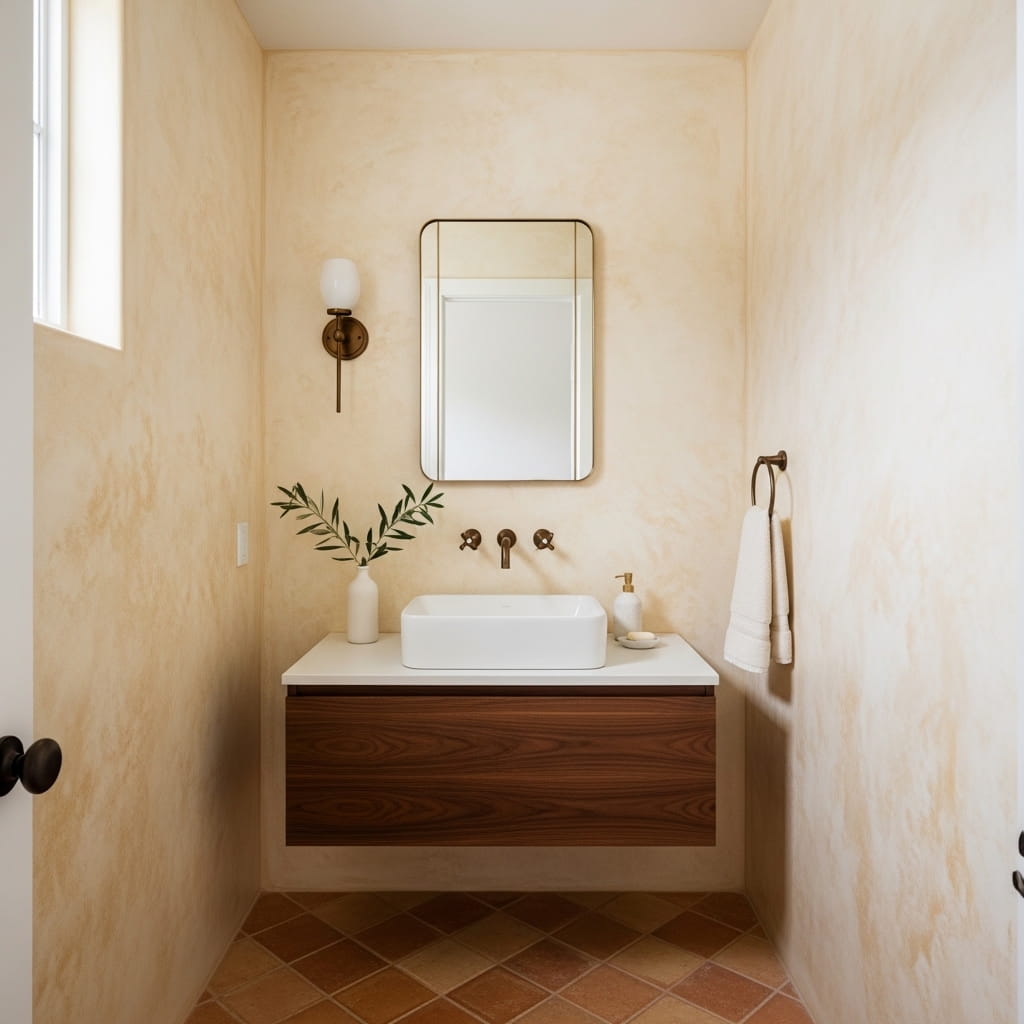
Limewash plaster walls in a compact bathroom create the most textured, artisan, and architecturally alive wall surface available from any paint-based application. Limewash applies in thin, translucent layers that build up a naturally mottled, aged-looking surface with subtle variations in color depth across the wall, creating a wall texture that looks genuinely centuries old rather than recently painted. This bathroom wall treatment suits Italian farmhouse, Mediterranean, artisan, and organic modern aesthetics with outstanding visual authenticity.
The natural color variation of limewash plaster , shifting from deeper ochre in the recesses to lighter cream on the raised surface textures , creates a living, dynamic wall surface that changes appearance as the light in the bathroom shifts from morning to evening. That light-responsive quality makes limewash plaster walls uniquely engaging compared to flat paint, which looks the same regardless of lighting conditions. I’ve noticed that people stand closer to limewash walls and touch them more often than any other wall surface because the texture is so unexpected and genuinely beautiful.
- Limewash creates aged, mottled, naturally varied texture
- Light-responsive surface changes with morning and evening
- No specialist tools required for DIY application
- Suits Italian farmhouse and Mediterranean aesthetics
- One of 2026’s most artisan bathroom wall treatments
Dark walnut floating vanity below the limewash walls adds deep, rich natural wood warmth that grounds the ochre and cream plaster tones with a third warm earth-toned material. The dark walnut’s rich brown depth connects to the warm ochre undertone in the limewash plaster without matching it exactly, creating a warm tonal relationship between the wall and the vanity that feels organic and naturally occurring. Aged brass faucet and a thin brass mirror frame add the final warm metallic accent that completes the Italian farmhouse material palette.
Terracotta Saltillo tile floor tiles ground the limewash plaster bathroom in a fourth warm earthy material that belongs completely to the Mediterranean design tradition that the limewash walls establish. The warm orange-red of the Saltillo tile echoes the deeper ochre tones in the limewash plaster above it, creating a vertical warm color echo from floor to ceiling. A small olive branch in a white ceramic bottle on the vanity counter adds a final organic Italian farmhouse detail that completes the artisan, warmly earthy character of this extraordinary bathroom design.
Skylight Natural Light Bathroom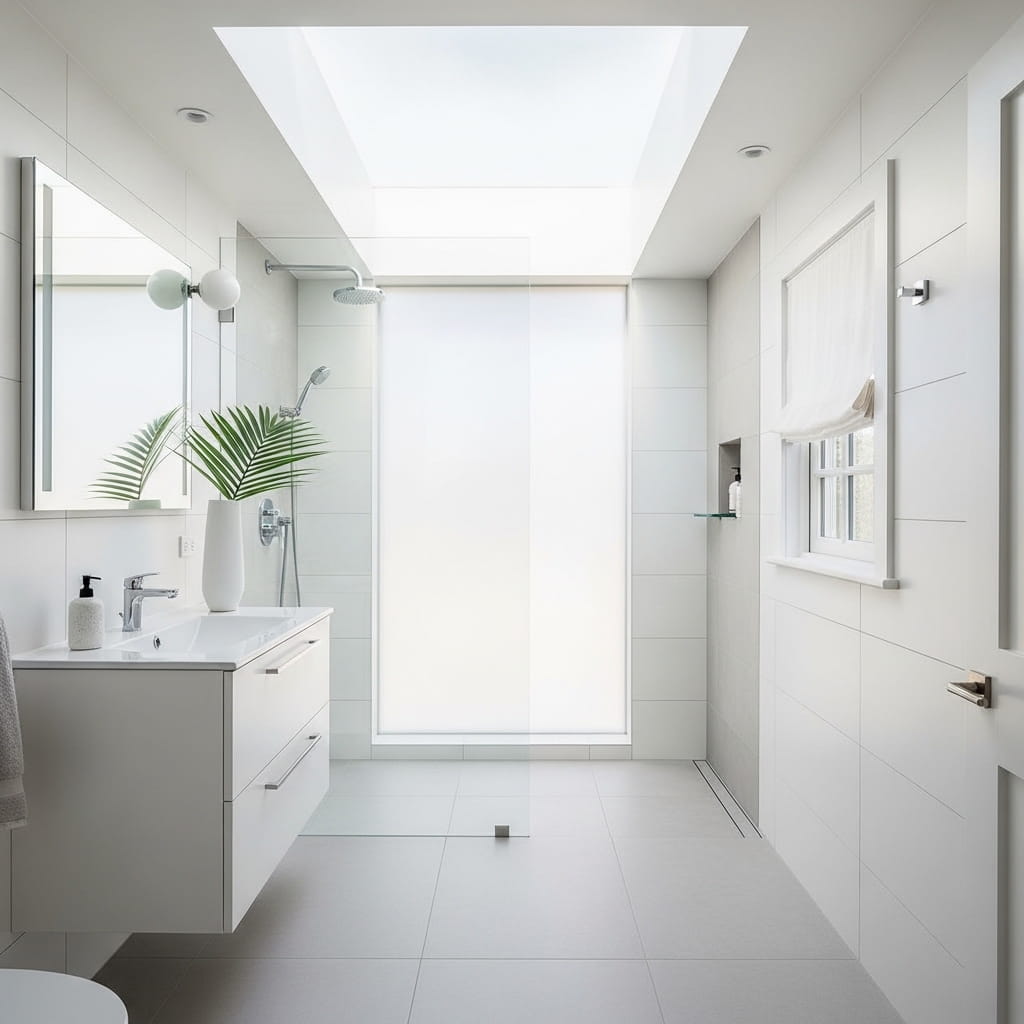
A skylight installed directly above a compact bathroom is the single most transformative natural light upgrade available for a bathroom that feels dark, cramped, or poorly lit throughout the day. Natural overhead light fills the entire bathroom simultaneously from every angle , unlike a single side window that illuminates only one zone , creating an even, diffused brightness that makes the room feel genuinely open and connected to the outdoor sky above. This small bathroom design idea suits top-floor apartments, bungalows, and any home where the bathroom sits below a roof surface.
Natural light from a skylight activates bathroom materials , tile gloss, mirror reflection, quartz countertop shimmer, and chrome hardware sparkle , in a way that artificial lighting simply cannot replicate. The direct overhead natural light source reveals the true colors, textures, and material qualities of every bathroom surface throughout the day. That material activation is why bathrooms with skylights consistently photograph more beautifully and feel more luxurious in person than technically superior bathrooms lit entirely by artificial fixtures.
- Skylight floods the entire room with natural light
- Natural light activates tile, chrome, and quartz beautifully
- Even overhead light removes shadowed dark bathroom zones
- Suits top-floor apartments and bungalow bathrooms
- Most transformative single upgrade for dark bathrooms
A frosted glass skylight rather than a clear glass skylight provides privacy while still admitting the full brightness of natural overhead light. The frosted surface diffuses the direct sunlight into a soft, even luminance that fills the bathroom gently without casting harsh direct sun beams onto the vanity mirror or shower floor. That soft, diffused natural light quality is what gives a skylight bathroom its distinctive serene atmosphere that feels meaningfully different from any artificially lit compact bathroom.
Pale gray large format floor tiles running continuously from the main bathroom floor directly into the shower area below the skylight maximize the natural light reflection from the floor surface upward. Light-toned large format floor tiles reflect natural skylight downward back upward toward the walls and ceiling, which multiplies the effective brightness of the natural light source significantly. That floor-based light reflection combined with the white tile walls and frameless glass shower screen creates a genuinely radiant, open, and beautiful compact bathroom that showcases the full potential of small bathroom design ideas at their very best.
Conclusion
Your bathroom size has never been the limitation , your ideas have. These 33 small bathroom design ideas prove that compact spaces are the most exciting design challenge in any home because every single choice matters and every detail shows. A bold tile floor, a sage green vanity, a frameless glass shower, or a dramatic arched mirror , any one of these ideas can completely change how your bathroom looks and feels every single day. I’ve seen one design decision shift a bathroom from forgettable to extraordinary. Save this post on Pinterest, share it with someone planning a bathroom refresh, and pick your first idea today. Your dream bathroom is closer than you think.
Frequently Asked Questions
How do I make a small bathroom look bigger?
Use large format floor tiles to reduce visible grout lines. Install a floating vanity to open up the floor visually. Add a floor-to-ceiling mirror on one wall to double the room’s perceived depth. Keep the upper walls light-toned. A frameless glass shower screen removes visual boundaries between bathroom zones effectively.
What color makes a small bathroom look larger?
Light neutral tones , soft white, warm cream, pale gray, and light sage green , make compact bathrooms feel more spacious. Large format tiles in light tones amplify the effect. Dark moody colors work too when applied continuously from floor to ceiling, removing visual boundaries that make rooms feel smaller and fragmented.
What is the best tile for a small bathroom floor?
Large format porcelain tiles in light neutral tones work best for small bathroom floors. They minimize grout lines and create a clean, continuous surface. Herringbone marble, terrazzo, and hexagon mosaic tiles add pattern interest without overwhelming small spaces. Choose non-slip textured tiles for shower floor areas specifically.
How much does a small bathroom remodel cost in 2026?
A basic small bathroom refresh , new paint, vanity hardware, mirror, and accessories , costs between $200 and $800. A mid-range remodel with new tile, vanity, and fixtures typically runs $3,000 to $8,000. A full high-end compact bathroom renovation with custom tile and freestanding fixtures can reach $15,000 to $25,000.
Can I use wallpaper in a small bathroom?
Yes, wallpaper works beautifully in small bathrooms and powder rooms. Use moisture-resistant or vinyl-coated wallpaper specifically designed for high-humidity spaces. Apply it to all four walls for a jewel-box effect. A bold botanical or geometric print transforms a powder room into the most memorable room in your home.
What lighting works best in a small bathroom?
Warm wall sconces at eye level on each side of the mirror provide the most flattering and functional bathroom lighting. Avoid relying solely on a single overhead fixture because it creates shadows. Recessed ceiling lighting with a dimmer switch adds flexible ambient light. Under-vanity LED strip lighting adds a warm, spa-like glow at floor level.
How do I add storage to a tiny bathroom without renovation?
Install floating wall shelves above the toilet for towel and toiletry storage. Add a recessed medicine cabinet above the vanity to replace a standard mirror. Use a woven basket on the floor beside the toilet for rolled towel storage. Over-door organizers on the back of the bathroom door add substantial storage with zero wall installation.